
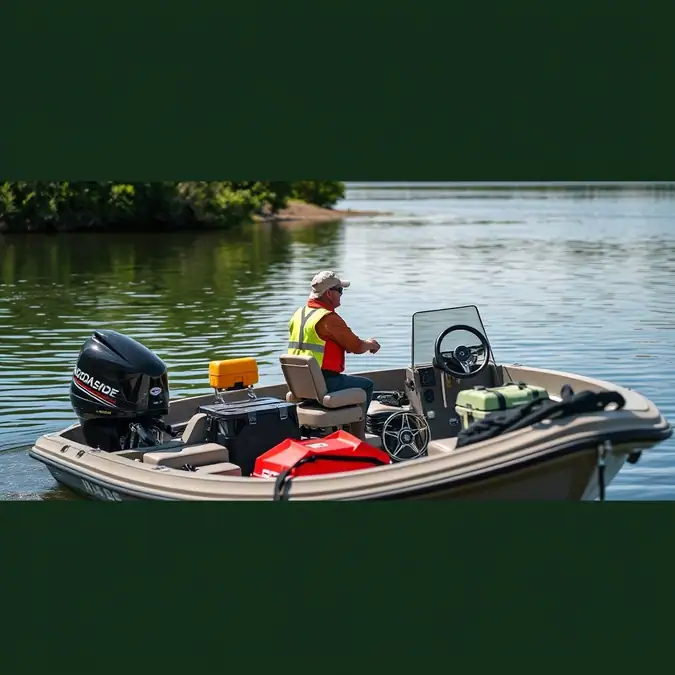
What Are the Legal Requirements for Jon Boat Safety Gear?

You push off from the dock and the sun glints on the water. Suddenly you wonder: do I have the right safety gear on board? This guide answers that question plainly. You will learn what the law says you must carry, why each item matters, and how to check it fast.
Table of Contents
- What safety gear does the law require for a jon boat?
- Which life jackets are approved and how many do I need?
- What type of fire extinguisher must I carry?
- What visual distress signals are needed?
- Do I need a sound‑producing device and what counts?
- What navigation lights are required after dark?
- Is a backfire flame arrestor needed on my engine?
- What ventilation rules apply to fuel compartments?
- When must I display a pollution placard?
- How often should I inspect and replace safety gear?
What safety gear does the law require for a jon boat?
The law sets a basic list of items you must have. This list keeps you and others safe on the water. It covers flotation, fire, signals, and lights. Knowing the list helps you avoid fines and danger.
Federal rules apply to all boats under 16 feet. Many states add a few extra rules. Always check your state’s boating guide for local adds.
The core items are: life jackets, fire extinguisher, visual distress signals, sound device, navigation lights, and a backfire flame arrestor if you have an inboard engine.
If your boat has a fuel tank, you also need proper ventilation. And if you are over 26 feet, a pollution placard is required.
Below is a simple table that shows each item and the minimum amount.
| Item | Minimum Required |
|---|---|
| Life jackets (wearable) | One per person |
| Throwable flotation | At least one |
| Fire extinguisher | One B‑I type |
| Visual distress signals | Three day‑night combo |
| Sound device | Whistle or horn |
| Navigation lights | Red, green, white (as needed) |
| Backfire flame arrestor | One on each carburetor |
| Ventilation | Two ducts (intake & exhaust) |
| Pollution placard | One if over 26 ft |
Keep this list on your console or in a waterproof bag. Check it before every trip.
If you miss any item, you risk a ticket and, more important, you risk your safety.
Next we look at each item in detail, starting with life jackets.
Which life jackets are approved and how many do I need?
Life jackets keep you afloat if you fall in. The law calls them personal flotation devices (PFDs). You need one that fits each person on board.
The jacket must be US Coast Guard approved. Look for the label inside the jacket. It will say “USCG Approved” and show a type number.
For a jon boat, Type II or Type III jackets work well. They are comfy enough to wear all day and will turn most wearers face up.
You must have a wearable jacket for every person. Plus you need at least one throwable device (a cushion or ring).
Check the fit: the jacket should not ride up over your chin or ears when you lift your arms. Snug but not tight.
If you have kids, get jackets sized for their weight. Do not rely on an adult jacket for a child.
Store jackets where you can grab them fast—under a seat or in a locker.
Inspect them monthly for rips, broken buckles, or waterlogged foam. Replace any that fail.
Remember: a jacket you never wear is useless. Wear it whenever the boat is moving.
What type of fire extinguisher must I carry?
A fire can start fast in a boat’s engine or galley. The law wants you to have a working extinguisher close at hand.
For boats under 26 feet with a fixed engine, you need one B‑I type extinguisher. This rating means it can put out flammable liquid fires.
The extinguisher must be marine‑rated. Look for the UL label and a date stamp. It should be charged and the pin intact.
Mount it where you can see it and reach it—near the helm or the engine hatch.
Check the pressure gauge each month. The needle should be in the green zone.
If the gauge shows low or the pin is missing, have it serviced or replace it.
You do not need more than one unless your boat has a galley or a fuel tank over a certain size. Then a second may be required.
Learn the PASS method: Pull the pin, Aim at the base of the fire, Squeeze the handle, Sweep side to side.
Practice this once a year so you act without thinking.
What visual distress signals are needed?
If you are in trouble, rescuers need to see you. Visual distress signals (VDS) give them a clear sign.
For boats under 16 feet used on inland waters, you need three day‑night signals. These can be flares, smoke signals, or an electric distress light.
Flares are the most common. You need three that work both day and night. Check the expiration date—most last three years.
Store flares in a dry, cool place. Keep them away from heat and sparks.
An approved orange smoke signal works for day use only. It can count as one of your three if you also have a night signal.
An electric distress light must flash the international SOS pattern. It must be waterproof and have a working battery.
Test the light before each trip. Replace the battery if it dims.
Never fire a flare near people or property. Aim it up and away from the boat.
If you use a flare, log the date and replace it after use.
Do I need a sound‑producing device and what counts?
Sound helps other boats know where you are, especially in fog or heavy rain. The law requires a means to make an audible signal.
Any whistle, horn, or bell that can make a loud blast works. It must be audible for at least one‑half mile.
A simple pea‑less whistle is cheap, light, and never fails. Attach it to your life jacket.
A horn can be air‑powered or electric. Check that it sounds loud and clear.
You do not need a bell unless you are on a commercial vessel.
Test your device before you go out. Blow the whistle or press the horn to be sure it works.
Keep it where you can grab it fast—on your console or in a pocket.
Remember: sound travels farther than light in fog. Use it early and often.
What navigation lights are required after dark?
When the sun sets, other boats need to see your heading and size. Navigation lights show your position and direction.
For a jon boat under 12 meters (about 39 feet), you need:
- A red light on the port (left) side.
- A green light on the starboard (right) side.
- A white light visible from all around (stern light) or a masthead light plus a stern light.
Lights must be on from sunset to sunrise and in times of reduced visibility.
Use LED bulbs—they last longer and draw less power.
Check each light before you leave. Look for cracked lenses, loose wires, or dim output.
If a light is out, replace the bulb or the whole unit right away.
Keep spare bulbs and a small screwdriver in your dry bag.
Proper lights keep you legal and help avoid collisions.
Is a backfire flame arrestor needed on my engine?
If your jon boat has an inboard gasoline engine, the law wants a flame arrestor on each carburetor. This stops a backfire from igniting fuel vapors.
Outboard motors do not need one because the carburetor is outside the hull.
The arrestor looks like a small metal screen. It must be USCG approved and fit snugly.
Inspect it each month for dents, holes, or loose fit. A damaged arrestor can fail when you need it most.
Clean it with a soft brush if you see dirt or oil buildup.
Never run the engine without the arrestor in place.
If you replace a carburetor, make sure the new one comes with an approved arrestor or buy one separately.
This simple part can save you from a fire in the engine compartment.
What ventilation rules apply to fuel compartments?
Fuel vapors are heavier than air and can collect in low spots. Proper ventilation moves those vapors out before they ignite.
The law requires two ventilation ducts for any closed compartment that holds a fuel tank.
- One intake duct brings fresh air in.
- One exhaust duct removes vapors out.
Each duct must be at least 3 square inches in area and lead to the open air.
Use flame‑resistant hose if you can. Keep the ends clear of debris.
Check the ducts before each trip. Look for cracks, loose clamps, or blockages.
If you smell gasoline, stop the engine and ventilate the area.
Never store portable fuel containers inside a closed locker without venting.
Good ventilation keeps the air safe and reduces fire risk.
When must I display a pollution placard?
A pollution placard reminds you and others to keep trash and oil out of the water. It is required on larger boats.
If your jon boat is 26 feet or longer, you must place a placard where it is easy to see.
The placard shows the MARPOL rules: no dumping of plastics, oil, or garbage.
You can buy a placard from a marine store or print one from the Coast Guard website.
Mount it near the helm or the galley where crew sees it often.
Check that it is clean, legible, and firmly attached.
Even if your boat is shorter, it is good practice to post a reminder.
A clean boat protects the water we all love.
How often should I inspect and replace safety gear?
Safety gear only works if it is in good shape. Set a simple routine to look it over.
Do a quick check before every launch: life jackets, fire extinguisher gauge, lights, and sound device.
Do a deeper check each month: examine flares, check expiration dates, test the horn, and look at ventilation ducts.
Replace any item that fails the test or is past its date.
Keep a log in a waterproof notebook. Write the date, what you checked, and any action taken.
If you use gear in an emergency, inspect it again and replace what was used.
Regular care takes a few minutes but can save a life.
Make it a habit, like checking your oil or tire pressure.
Frequently Asked Questions About Jon Boat Safety Gear
What if I only boat on a small lake?
Even on small lakes you must carry the same basic gear: life jackets, fire extinguisher, signals, sound device, and lights if you go after dark. Local rules may add a life jacket wear rule.
Can I use a kayak PFD on my jon boat?
Yes, if the PFD is USCG approved and fits the wearer. Type III jackets made for paddling work well on jon boats.
Do I need a registration number visible on the boat?
Yes. Your state registration numbers must be displayed on the forward half of the boat, block letters, at least three inches high, and contrast with the hull.
Is a whistle enough for a sound device?
A whistle that can be heard for half a mile meets the rule. Many boaters carry a whistle on each life jacket for backup.
Where can I find my state’s exact boating laws?
Visit your state’s natural resources or fish and game website. Most have a free PDF boating handbook.
Final Thoughts
The single most important takeaway is to check your safety gear before every trip. A few minutes of inspection can keep you legal and keep you and your friends safe on the water. Now go out, enjoy the ride, and come back happy.
1 thought on “what are the legal requirements for jon boat safety gear: 5 Tips”