
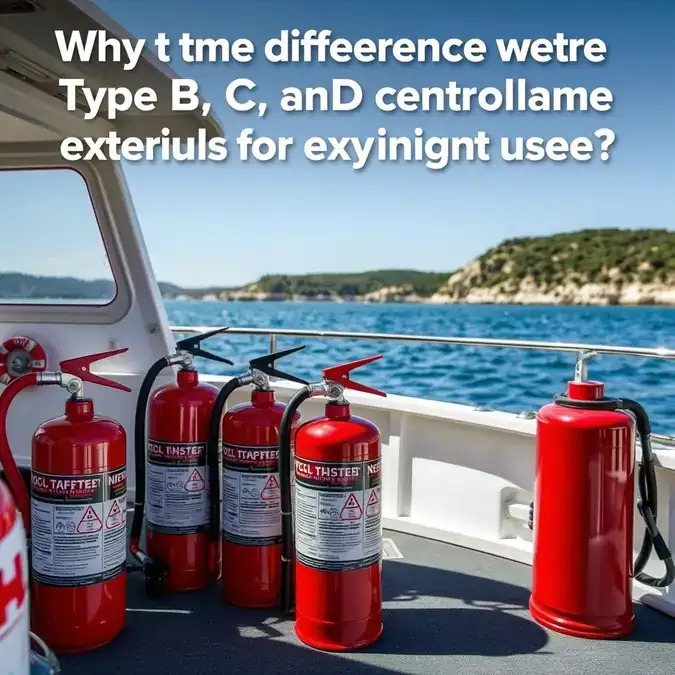
What Is the Difference Between Type B, C, and D Extinguishers for Marine Use?
I was standing on my buddy’s 28-foot center console last summer when he asked me to check his fire extinguishers before a Coast Guard inspection. He had three red cylinders mounted near the helm — one labeled B-I, another B-II, and a third with a C rating. He looked at me and said, “So which one do I grab if the galley stove flares up? What about an electrical short behind the dash?” That question — what is the difference between Type B, C, and D extinguishers for marine use — is exactly what sends most boat owners down a rabbit hole of Coast Guard letters, UL numbers, and agent types. I’ve spent fifteen years running charters in the Keys and teaching USCG safety courses, and I still see seasoned captains mix these up. By the end of this article, you’ll know exactly which extinguisher handles burning fuel, which tackles live wiring, and why Type D is in a category all its own.
- Type B extinguishers fight flammable liquid fires — gasoline, diesel, oil, grease
- Type C extinguishers handle energized electrical equipment fires — wiring, batteries, panels
- Type D extinguishers are for combustible metal fires — magnesium, titanium, aluminum (rare on recreational boats)
- Most marine extinguishers are multi-class rated (like B:C or A:B:C) — one cylinder covers multiple hazards
- USCG requires B-I or B-II rated units on most recreational vessels — the Roman numeral indicates capacity, not a different fire class
- Mount extinguishers within reach of the helm, galley, and engine room — not buried in a locker
- Inspect monthly: check pressure gauge, shake dry chemical units to prevent caking, verify bracket security
- Replace or recharge every 12 years (disposable) or per manufacturer service schedule (rechargeable)
Introduction

Picture this: you’re thirty miles offshore, the sun’s going down, and a smell hits you — sharp, chemical, unmistakably burning insulation. Your first instinct is to grab the red cylinder by the helm. But which one? The label says “B:C” on one, “A:B:C” on another, and there’s a weird yellow one marked “D” tucked in the engine room. Your heart pounds. You have seconds. This isn’t theoretical — I’ve watched a charter captain freeze in that exact moment because he didn’t know if his electrical fire needed the B unit or the C unit. The truth? For marine use, you almost never need a pure Type D. You need to understand what B and C actually cover, why they’re almost always combined, and what those Roman numerals (I, II, III) really mean for your boat’s safety. Let’s break it down like we’re sitting at the dock bar with a cold drink.
Why Use What Is the Difference Between Type B, C, and D Extinguishers for Marine Use?

You use this knowledge because the Coast Guard doesn’t care about your intentions — they care about your equipment matching the hazards on your boat. A gasoline vapor explosion in the bilge acts nothing like a shorted battery charger behind the nav station. Type B agents (usually dry chemical or clean agent) smother liquid fuel fires by interrupting the chemical chain reaction. Type C agents are non-conductive so you can blast a live 12V or 120V panel without getting zapped or making it worse. Type D? That’s for burning magnesium engine blocks or titanium dive gear — stuff 99% of recreational boaters never carry. Knowing the difference means you buy the right extinguishers, mount them where they matter, and pass inspection without the examiner shaking his head. It also means you don’t waste money on a Class D unit when a $45 B:C covers your real risks.
Benefits of Using What Is the Difference Between Type B, C, and D Extinguishers for Marine Use?

The benefit is simple: you match the tool to the threat. When you understand that Type B handles the diesel spill in the engine room and Type C handles the smoking inverter, you stop guessing. You mount a B:C by the helm (electrical panel + fuel lines nearby), a B:C in the galley (cooking oil + stove wiring), and a larger B-II near the engine room (bigger fuel volume). You sleep better knowing your crew can actually fight the fire instead of reading labels while the boat burns. Insurance underwriters love this — proper extinguisher placement and classification often lowers premiums. And when the USCG boards you for a random safety check, you hand them a clean inspection sheet instead of a violation notice. That peace of mind? Priceless.
Types of What Is the Difference Between Type B, C, and D Extinguishers for Marine Use?
Type B — Flammable Liquid Fires
Type B is your bread and butter on a boat. Gasoline, diesel, engine oil, hydraulic fluid, cooking oil — they’re all Class B fuels. The extinguisher uses dry chemical (monoammonium phosphate or sodium bicarbonate), clean agent (Halon alternatives like FE-36 or Novec 1230), or CO2 to blanket the fuel surface and cut off oxygen. On a recreational vessel, you’ll almost never see a pure “Type B only” extinguisher. They’re virtually always rated B:C or A:B:C because electrical hazards live right next to fuel hazards. The Coast Guard classification “B-I” or “B-II” refers to capacity, not a sub-class. B-I is the smaller size (typically 2 lb dry chemical or 2.5 lb clean agent). B-II is larger (typically 5–10 lb dry chemical or 5 lb clean agent). B-III exists but is rare on boats under 65 feet.
Type C — Energized Electrical Fires
Type C means the agent won’t conduct electricity. That’s it. It doesn’t mean “electrical fire extinguisher” as a separate thing — it means you can safely discharge it on live equipment. Dry chemical, clean agents, and CO2 are all non-conductive. Water and foam are NOT Type C — never spray water on a live panel. On boats, every circuit panel, battery bank, shore power inlet, and inverter is a Class C hazard. Since these sit right next to fuel lines and engine compartments, the industry standard is a combination B:C or A:B:C rating. You get both protections in one cylinder. Pure Type C extinguishers don’t really exist for marine use — they’d be useless on a fuel fire.
Type D — Combustible Metal Fires
Type D is the oddball. It’s for burning metals: magnesium, titanium, zirconium, sodium, potassium. The agent is a special dry powder (usually sodium chloride based or copper based) that forms a crust over the molten metal. You’ll find Type D in machine shops, aerospace hangars, and some commercial dive operations that use magnesium lights or titanium tools. On a typical recreational boat — even a liveaboard trawler — you have zero Class D hazard. Your engine block is aluminum alloy, not pure magnesium. Your dive gear is aluminum, not burning titanium. Don’t buy a Type D for your boat. It’s expensive, single-purpose, and useless on the fires you’ll actually face.
Popular Types of What Is the Difference Between Type B, C, and D Extinguishers for Marine Use?
Dry Chemical (ABC or BC) — The Workhorse
Red cylinder, white powder inside. Monoammonium phosphate (ABC) or sodium bicarbonate (BC). Cheap, effective, widely available. Downsides: the powder is corrosive, messy, and destroys electronics if you blast a panel. It also cakes over time — shake it monthly. USCG B-I and B-II ratings are commonly met with 2.5 lb and 5 lb ABC units. Brands like Kidde, First Alert, and Amerex dominate marine chandleries.
Clean Agent (FE-36, Novec 1230, Halotron) — The Electronics Friend
These leave zero residue. Non-conductive, non-corrosive, safe for engines, computers, and expensive nav gear. They work by heat absorption and chemical interruption. More expensive ($80–$200 per unit) but worth it near sensitive equipment. FE-36 is the most common marine clean agent. Novec 1230 is newer, lower environmental impact. Halotron is the older Halon replacement. All meet B:C ratings. Many carry USCG B-I or B-II approval.
CO2 — The Classic Clean Agent
Carbon dioxide displaces oxygen. No residue, non-conductive. But: short range (3–8 feet), very cold discharge (frostbite risk), and dangerous in enclosed spaces — it displaces breathing air. CO2 units are heavy (10+ lb for a 5 lb capacity) and require hydrostatic testing every 5 years. Rare on modern recreational boats but still seen on older commercial vessels.
Water Mist / Foam — Rarely Marine Primary
Water mist (Type A:C) and foam (Type A:B) exist but aren’t standard for marine primary protection. Foam works on fuel spills but conducts electricity. Water mist is non-conductive but limited capacity. You might see them as supplements on larger yachts with dedicated fire stations.
How to Choose What Is the Difference Between Type B, C, and D Extinguishers for Marine Use?
Start with your boat’s length and hazard zones. USCG minimums: boats under 26 feet need one B-I. 26–40 feet need two B-I or one B-II. 40–65 feet need three B-I or one B-I + one B-II. Over 65 feet? Different rules entirely. But minimums are just that — minimums. I recommend: one B:C clean agent at the helm (electronics + fuel lines), one B:C dry chemical in the galley (cooking fire + stove wiring), one B-II dry chemical or clean agent in the engine room (volume + access), and one spare in the cockpit locker. Match the agent to the location: clean agent near electronics, dry chemical where mess doesn’t matter. Check for USCG approval label (160.0xx series) and UL marine rating. Avoid “home” units without marine brackets — vibration kills them. Buy rechargeable if you want long-term value; disposable if you’ll replace in 12 years anyway.
Installation and Setup of What Is the Difference Between Type B, C, and D Extinguishers for Marine Use?
Mount them where you’ll reach them in smoke, darkness, and panic. Helm station: within arm’s reach of the wheel, bracket secured to a bulkhead — not a cabinet door that might jam. Galley: near the exit, not over the stove (you can’t reach it if the stove is burning). Engine room: outside the compartment, near the hatch, so you don’t have to enter a burning space to get it. Cockpit: accessible from the helm and the companionway. Use USCG-approved marine brackets — metal, not plastic, with a quick-release strap. Angle the cylinder so the gauge is readable at a glance. Label the bracket with a waterproof tag: “ENGINE ROOM — B-II” or “HELM — B:C CLEAN AGENT.” Don’t hide them behind cushions, in lazarettes, or under bunks. The Coast Guard will check. So will the fire.
Tips for Using “What Is the Difference Between Type B, C, and D Extinguishers for Marine Use?” Effectively
- Remember PASS: Pull the pin, Aim at the base, Squeeze the handle, Sweep side to side
- Stand 6–8 feet back — don’t crowd the fire
- For fuel fires, aim at the base of the flames, not the middle
- For electrical fires, confirm power is off if possible — but Type C agents work live
- Don’t use a Type B extinguisher on a Class A (wood, paper, fabric) fire unless it’s rated A:B:C
- Shake dry chemical units upside down monthly — prevents powder caking
- Check the gauge monthly — needle in the green means charged
- Replace disposable units at 12 years from manufacture date (stamped on cylinder)
- Rechargeable units need professional service every 6 years (internal exam) and hydro test every 12 years
- Teach every crew member — kids included — where they are and how to use them
How It Works for Me
On my 34-foot express cruiser, I run three extinguishers. A 2.5 lb FE-36 clean agent (B:C, USCG B-I) at the helm — right next to the MFDs, VHF, and breaker panel. A 5 lb ABC dry chemical (A:B:C, USCG B-II) in the engine room bracket, mounted on the bulkhead just outside the hatch. A 2.5 lb ABC in the galley, by the companionway ladder. Every month, first Saturday, I pull each one, check the gauge, shake the dry chemical units, verify the brackets haven’t loosened from vibration, and wipe the labels clean. Every six years, the rechargeables go to the fire shop for internal inspection. Every twelve years, they get hydro-tested or replaced. It takes twenty minutes a month. That’s cheaper than a boat — or a life.
What I Like
I like that the system is logical once you strip away the jargon. Type B = liquid fuel. Type C = live wires. Type D = weird metals you don’t have. The Roman numerals just mean “how much agent.” The combination ratings (B:C, A:B:C) mean one cylinder does double or triple duty. Clean agent technology means I don’t have to choose between saving my $12,000 electronics suite and putting out a fire. And the USCG standards, while sometimes frustrating, create a baseline that actually works — boats with proper extinguishers rarely burn to the waterline. The monthly shake-and-check ritual also forces me to look at my bilge, my wiring, my fuel lines — catching problems before they become fires.
What Could Be Better
The labeling is still confusing. “B-I” looks like a sub-class to new boaters. It’s not — it’s a size. The Coast Guard should require “2 lb B:C” or “5 lb B:C” on the approval label instead of “B-I.” Clean agent refills are expensive and not every marine shop does them — you often ship the cylinder out. Dry chemical residue is a nightmare on modern CAN bus electronics; one blast can total a $4,000 display. And nobody teaches PASS in the basic boating safety course — they mention extinguishers but don’t drill it. I’ve seen grown men try to unscrew the hose instead of pulling the pin. That’s a training gap, not an equipment gap.
My Personal Experience
Twenty-three years ago, I watched a neighbor’s 31-foot sportfish burn at the dock in Marathon. Electrical short in the battery charger. He grabbed the extinguisher from the engine room — a B-II dry chemical — but he had to run through the smoke to get it. By the time he got back, the V-berth was involved. The fire department saved the hull but the interior was gone. He had the right extinguisher. Wrong location. That lesson stuck. On my own boat, I’ve had two close calls. Once, a galley stove flare-up from a grease pan. The ABC by the companionway knocked it down in five seconds. Second time, a smoking inverter behind the nav station. The clean agent at the helm saved the electronics — zero residue, zero corrosion. Both times, the extinguisher was exactly where muscle memory put it. That’s not luck. That’s placement.
Recommendation
If you’re outfitting a boat today, start with the USCG minimum for your length — then add two more. Put a clean agent B:C at the helm. Put a dry chemical A:B:C in the galley. Put a B-II dry chemical or clean agent at the engine room hatch. If you have a dedicated generator compartment, add a fourth there. Buy USCG-approved, UL-listed, marine-bracketed units. Spend the extra $30 on clean agent for the helm — your electronics will thank you. Set a calendar reminder for monthly checks. Replace disposables at 12 years. Service rechargeables on schedule. And for the love of Neptune, teach your crew PASS before you leave the dock.
How to Use What Is the Difference Between Type B, C, and D Extinguishers for Marine Use? Effectively
Fire doesn’t wait for you to read the label. Practice PASS until it’s automatic. Pull the pin — it’s usually a ring or loop, twist to break the seal. Aim at the base of the fire, not the flames. Squeeze the lever slowly — don’t jerk it. Sweep side to side, advancing only as the fire recedes. For a bilge fuel fire, aim at the forward edge of the fuel pool and sweep aft. For an electrical panel, blast the base of the arcing breaker — the agent will penetrate the enclosure. For a galley grease fire, aim at the pan’s near edge and sweep across — don’t splash the grease. Never turn your back on a knocked-down fire. Re-flash is real. Back away slowly, watch for reignition, and have a second extinguisher ready. If the fire’s bigger than a wastebasket when you arrive, get everyone off the boat. Call Mayday. The extinguisher buys you escape time — it’s not a firefighter’s tool.
What Is the Difference Between Type B, C, and D Extinguishers for Marine Use? Alternatives
There aren’t true “alternatives” to carrying USCG-required extinguishers — it’s federal law. But you can supplement. Automatic engine room systems (Fireboy, Sea-Fire, Kidde) discharge clean agent when a heat sensor trips — they’re not a replacement for portables, but they fight fires while you’re asleep or away. Fire blankets (wool or fiberglass) are excellent for galley pan fires — no mess, no residue, reusable. Stove-top suppression canisters (StoveTop FireStop) mount under the range hood and auto-deploy. For lithium-ion battery fires (e-bikes, scooters, power tools), specialized F-500 or AVD extinguishers exist — but they’re niche and not USCG-classified for primary protection. Bottom line: portables are mandatory. Everything else is a layer.
My Personal Recommendation
For most recreational boats 26–45 feet, I’d spec this package: Amerex B456 5 lb ABC Dry Chemical (B-II) for the engine room, H3R Performance HG100C 2.5 lb Halotron Clean Agent (B:C, B-I) for the helm, and Kidde Pro 210 4 lb ABC Dry Chemical (B-I) for the galley. Total cost: around $350. Covers every realistic hazard, passes any USCG inspection, and gives you clean agent where it matters most. Mount them with Amerex 817 marine brackets — stainless, quick-release, vibration-proof. Set your phone reminder for the first Saturday of every month. Check Amerex specs here and H3R clean agent data here — both are solid, USCG-approved manufacturers I’ve trusted for years.
Quick Comparison Table
| Feature | Dry Chemical (ABC) | Clean Agent (FE-36 / Novec) | CO2 |
|---|---|---|---|
| Classes Covered | A, B, C | B, C | B, C |
| Residue | Heavy — corrosive powder | None | None |
| Electronics Safe | No — destroys circuits | Yes | Yes |
| Range | 10–20 ft | 10–15 ft | 3–8 ft |
| Cost (2.5–5 lb) | $35–$65 | $80–$200 | $120–$250 |
| Maintenance | Shake monthly, 6/12 yr service | Gauge check, 6/12 yr service | Hydro test every 5 yr |
| Best Marine Location | Engine room, galley, cockpit | Helm, nav station, battery bank | Legacy only — not recommended |
FAQs
What does B-I mean on a marine fire extinguisher?
B-I is a USCG capacity rating for Type B extinguishers — roughly 2 lb dry chemical or 2.5 lb clean agent. It’s the minimum size for boats under 26 feet.
Can I use a home fire extinguisher on my boat?
No. Home units lack USCG-approved marine brackets and corrosion-resistant components. Vibration and salt air will fail them. Use only USCG/UL marine-listed extinguishers.
Do I need a Type D extinguisher on my boat?
Almost certainly not. Type D is for burning magnesium, titanium, and similar metals — hazards not found on recreational vessels.
What’s the difference between B-I and B-II?
Capacity. B-I is the smaller size (~2–2.5 lb agent). B-II is larger (~5–10 lb agent). Both fight Class B (and usually C) fires — B-II just lasts longer.
How often should I replace my marine fire extinguishers?
Disposable units: 12 years from manufacture date. Rechargeable units: service every 6 years (internal), hydrostatic test every 12 years, replace if they fail inspection.
Where should I mount fire extinguishers on my boat?
At the helm, galley exit, engine room hatch (outside), and cockpit. Within arm’s reach, visible, on USCG-approved brackets — never in lockers or behind gear.
Is a clean agent extinguisher worth the extra cost?
Yes, for the helm and any location near electronics. Zero residue means no corrosion damage to MFDs, radios, or CAN bus networks after discharge.
What does the “C” rating actually mean?
The agent is non-conductive. You can safely discharge it on energized electrical equipment (12V, 120V, 240V) without shock risk or arc propagation.
Conclusion
Here’s the bottom line: Type B kills fuel fires. Type C kills electrical fires without killing you. Type D is for metals you don’t have. On a boat, you want B:C or A:B:C combination units — clean agent at the helm, dry chemical in the engine room and galley. Mount them where you can grab them in the dark, choking on smoke. Check them monthly. Replace them on schedule. Teach your crew PASS. I’ve seen the right extinguisher in the right hand save a boat. I’ve seen the wrong one — or the right one in the wrong place — lose one. Don’t guess. Know. Your boat, your people, your responsibility. Now go check your brackets.