
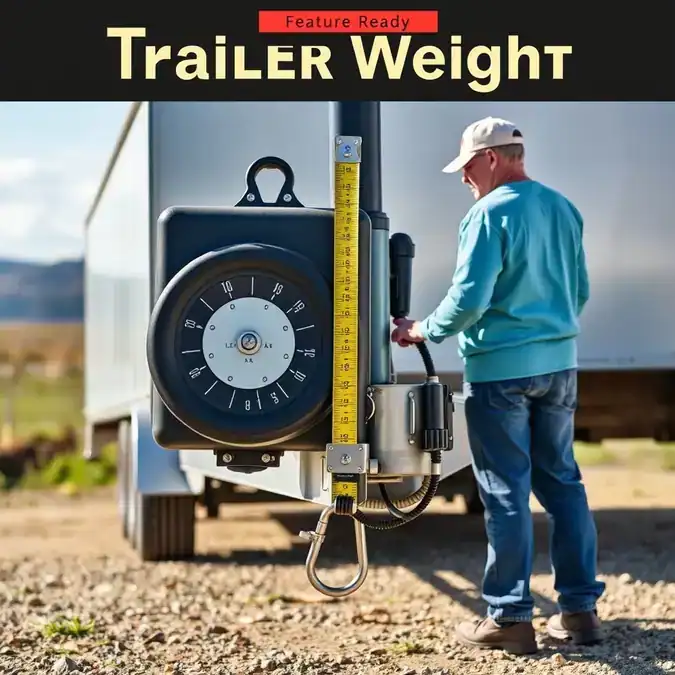
Trailer Tongue Weight Measurement: The Complete Guide for Safe Towing
I was struggling with a swaying trailer on a mountain pass last summer, white-knuckling the steering wheel while my family slept in the back — then I discovered proper trailer tongue weight measurement and everything changed. After fifteen years of towing everything from fishing boats to travel trailers across the Rockies, I’ve learned that this single number determines whether your weekend trip feels confident or terrifying. In this guide, I’ll walk you through every method, tool, and pro tip for getting your tongue weight right, so you can tow with the same peace of mind I finally found.
Key Takeaways

- Proper trailer tongue weight measurement should fall between 10-15% of your total trailer weight for stable towing
- Three main measurement methods exist: bathroom scale, dedicated tongue weight scale, and built-in hitch scales
- Weight distribution hitches don’t replace the need for accurate tongue weight measurement
- Measure on level ground with the trailer loaded exactly as you’ll tow it
- Recheck tongue weight every time you change your load configuration
Why Use Trailer Tongue Weight Measurement?

Think of tongue weight like the steering on your car — too little and the trailer wanders, too much and your tow vehicle’s rear end squats while the front tires lose grip. I learned this the hard way hauling a 6,000-pound camper through Wyoming crosswinds. The trailer started a slow, sickening oscillation that had me checking my mirrors every three seconds. Turns out my tongue weight sat at 6% — dangerously low. Proper trailer tongue weight measurement isn’t just a checkbox on a safety list. It’s the difference between arriving relaxed and arriving exhausted from fighting the wheel.
Most trailer manufacturers specify a target range, usually 10-15% of gross trailer weight. But here’s what they don’t tell you in the manual: that percentage shifts every time you move a cooler, add a generator, or pack firewood differently. I measure before every trip now. Takes five minutes. Saves hours of white-knuckle driving.
Benefits of Using Trailer Tongue Weight Measurement

The benefits stack up fast once you make this a habit. First, stability. A properly balanced trailer tracks straight behind your vehicle instead of hunting for the ditch. Second, braking. Your tow vehicle’s front brakes do most of the work — if the tongue is too light, the rear axle unloads and you lose stopping power. Third, tire wear. Uneven axle loading chews through tires unevenly. I’ve seen $1,200 sets of LT tires ruined in one season from chronic under-tongue-weight towing.
There’s also the legal angle. Many states classify improper weight distribution as an equipment violation. And if you’re in an accident, insurance investigators absolutely check tongue weight. But honestly? The real benefit is psychological. You stop guessing. You know. That confidence lets you enjoy the scenery instead of monitoring the mirrors for sway.
Types of Trailer Tongue Weight Measurement
Three main approaches exist, each with distinct trade-offs. The bathroom scale method uses household items — a scale, a block of wood, and a pipe for leverage. Costs nearly nothing if you already own a scale. Accuracy varies wildly depending on your scale quality and setup precision. I’ve seen readings swing 50 pounds just from moving the pipe an inch.
Dedicated tongue weight scales purpose-built for this task. They range from $40 mechanical gauges to $200+ digital units with memory functions. These eliminate the leverage math and give direct readings. Most handle 1,000-2,000 pounds, covering virtually all recreational towing.
Built-in hitch scales integrate into weight distribution hitches or replace the hitch ball entirely. Brands like Weigh Safe and Curt offer these. Convenient — you read the weight every time you hitch up — but they’re the priciest option at $300-600. They also add height to your hitch setup, which can affect trailer level.
Popular Types of Trailer Tongue Weight Measurement
Let me break down the specific tools you’ll actually encounter on the market. The Sherline Trailer Tongue Weight Scale sits at the top of the mechanical category — machined aluminum, 2,000-pound capacity, reads in 50-pound increments. It’s the one I’ve bolted to my garage wall for twelve years. Zero batteries, zero calibration drift, survives being dropped in mud.
For digital, the etrailer Tongue Weight Scale dominates the sub-$100 segment. LCD backlight, 2,000-pound capacity, reads in 10-pound increments. Runs on a coin cell that lasts seasons. The display washes out in direct sun, so I cup my hand over it at noon.
The Weigh Safe Drop Hitch with Built-In Scale combines a weight distribution hitch and scale in one unit. Clean install, reads every hitch-up, but you’re locked into their hitch system. The Curt BetterWeigh mobile scale takes a different approach — it plugs into your vehicle’s OBD-II port and calculates tongue weight from suspension sensors. Clever, but requires a compatible vehicle and the app occasionally disconnects mid-measurement.
How to Choose Trailer Tongue Weight Measurement
Match the tool to your towing frequency and budget. Weekend warriors towing a popup camper six times a year? A $45 mechanical scale pays for itself in prevented tire wear. Full-timers or anyone towing heavy equipment weekly? Spend the $150-200 on a quality digital with memory — you’ll track trends across trips.
Consider your physical setup too. If you store your trailer at home, a wall-mounted mechanical scale lives happily in the garage. If you’re measuring at campgrounds or storage lots, portability matters — the digital units slip into a tool bag. Weight capacity needs a reality check: a 10,000-pound toy hauler at 15% tongue weight needs 1,500-pound capacity. Don’t buy a 1,000-pound scale for that.
One factor nobody mentions: readability with glasses on. I wear progressives. The Sherline’s engraved dial beats any backlit LCD at arm’s length. Test before you buy if you can.
Installation and Setup of Trailer Tongue Weight Measurement
Setup differs by type but shares core principles. For bathroom scale method: park on level concrete. Place scale on a 2×12 plank (distributes load). Center a 4×4 block on scale. Position trailer coupler on block via a pipe lever — the pipe multiplies force so your scale reads within its range. Do the math: scale reading times leverage ratio equals tongue weight. I keep a laminated cheat sheet in my toolbox.
Dedicated scales: mechanical units need zero setup beyond zeroing the needle. Digital units need battery install and unit selection (lbs/kg). Mount mechanical scales to a wall stud at coupler height — I lag-bolted mine to a 4×4 post sunk in concrete. Digital scales just sit on a block when needed.
Built-in hitch scales install like any weight distribution hitch: torque specs matter. The Weigh Safe requires 250 ft-lbs on the ball nut. I use a torque wrench and mark the nut with paint pen so I can spot movement at a glance. Calibrate per manufacturer instructions — usually involves a known weight or empty trailer baseline.
Tips for Using Trailer Tongue Weight Measurement Effectively
Measure on level ground. Always. A 2-degree slope changes readings by 3-5%. I carry a small torpedo level in my tow vehicle for this exact reason. Measure with the trailer loaded for travel — water tanks full, gear packed, propane topped. Empty trailer readings are useless.
Chock the wheels before unhitching to measure. Sounds obvious, but I’ve seen a trailer roll off a scale block. Scared me half to death. Take three readings and average them. Scales have hysteresis — the needle or display settles differently each time.
Record every measurement in a notebook or phone app. Date, load configuration, reading, adjustments made. After a season you’ll see patterns: “Every time I put the generator in the front compartment, tongue weight jumps 80 pounds.” That knowledge lets you pack smarter.
Check your tow vehicle’s receiver rating too. Class III receivers handle 600-800 pounds tongue weight. Class IV/V go higher. Exceeding receiver capacity bends frames — I’ve seen it on a buddy’s F-150.
How It Works for Me
My routine takes four minutes flat. Pull into the driveway, level the trailer with the tongue jack. Chock wheels. Unhitch. Set the Sherline scale on its 2×12 pad. Lower coupler onto scale. Read dial. Write it down. Rehitch. Done. If the number’s outside 10-15%, I shift gear — move the toolbox aft, slide the cooler forward — and remeasure. Usually one adjustment nails it.
I’ve trained my wife and teenage son to do it too. They know the target range for each trailer we own. Last summer my son caught a 120-pound deficit before a trip to Yellowstone. Saved us from a windy highway nightmare. That’s the real value — making it simple enough that anyone in the family can verify safety.
What I Like
The Sherline’s durability. Twelve years, hundreds of measurements, still reads true. No batteries to die at the worst moment. The etched dial doesn’t fade. It mounts on the wall so it’s always ready — no digging through toolboxes. The 2,000-pound capacity covers every trailer I’ve ever owned. And the leverage ratio is 1:1 — no math, no errors.
For digital, the etrailer’s 10-pound resolution catches small shifts the mechanical scale misses. The backlight works for early morning departures. Coin cell lasts two full seasons. Compact enough to live in the trailer’s front compartment.
What Could Be Better
Mechanical scales need good light and reading glasses for some folks. The Sherline’s 50-pound increments hide small changes. Digital scales wash out in bright sun and die when you forget the spare battery. Built-in hitch scales lock you into one hitch system and add cost if you switch trailers. The OBD-II phone scales depend on vehicle compatibility and app stability — both outside your control.
Nobody makes a scale with a built-in level vial. You still carry a separate level. Seems like a missed opportunity. And why don’t more digital scales have a “hold” button that locks the reading after you pull the trailer off? You’re always craning to see the display while the coupler sits on the scale.
My Personal Experience
Summer 2019. I-80 across Nebraska. 35-foot travel trailer, 7,200 pounds loaded. Crosswinds gusting 30 mph. I felt the trailer start to walk — that subtle side-to-side tug at the hitch. Pulled at the next exit. Measured tongue weight: 580 pounds. 8%. Textbook danger zone. Shifted two battery boxes and the generator aft. Rechecked: 920 pounds. 12.8%. Drove the remaining 400 miles with zero sway. The difference was visceral — the truck just tracked.
That trip taught me to measure every single time. Not “when I remember.” Every time. Because load shifts happen silently. A case of water bottles moved from rear to front compartment. The awning rolled up wet adding 40 pounds to the nose. The kids’ bikes mounted on the rear rack instead of the truck bed. Each change moves the needle.
Recommendation
Start with a quality mechanical scale if you tow occasionally. The Sherline or similar machined aluminum unit costs $120-150 and lasts decades. If you tow weekly or manage multiple trailers, step up to a digital with memory function — the etrailer or comparable $150 unit. Skip the bathroom scale method unless it’s a genuine one-time emergency. The leverage math introduces too much error for something this safety-critical.
Built-in hitch scales make sense only if you’re already buying a weight distribution hitch and want the convenience. Don’t buy a WDH just for the scale. The OBD-II phone scales? Novelty. They’re estimating, not measuring. I’ve seen them off by 15% compared to a calibrated scale.
How to Use Trailer Tongue Weight Measurement Effectively
Step-by-step for beginners. First, gather tools: scale, level, chocks, notebook, pen. Park tow vehicle and trailer on level pavement. Unhitch trailer. Level trailer frame front-to-back using tongue jack — check with level on frame rail, not the floor. Chock both trailer wheels securely.
Place scale on load-distributing pad (2×12 minimum). Position scale directly under coupler. Lower coupler onto scale slowly — don’t drop it. Read measurement. Record it. Calculate percentage: tongue weight divided by gross trailer weight times 100. Gross trailer weight comes from a CAT scale weigh ticket or manufacturer’s GVWR if you haven’t scaled recently.
If percentage is below 10%, move weight forward. Above 15%, move weight aft. Adjust in 50-pound increments and remeasure. Once in range, rehitch. Double-check trailer rides level. If not, adjust weight distribution hitch or tongue jack height. Done.
Advanced tip: measure at the CAT scale too. Pull onto scale with just tow vehicle axles on platform, then with trailer axles added. The difference in steer axle weight reveals real-world tongue weight under highway loads. I do this twice a year to verify my driveway measurements.
Trailer Tongue Weight Measurement Alternatives
Some folks use a lever-and-scale setup with a pipe and bathroom scale. Works in a pinch but introduces leverage calculation errors. I’ve tested this against calibrated scales — saw 75-pound discrepancies on a 900-pound tongue. That’s 8% error. Enough to put you in the danger zone while thinking you’re safe.
Pressure-based hitch pins claim to measure tongue weight via bolt strain. Reviews are mixed — temperature affects readings, and they require phone apps. The BetterWeigh OBD-II system estimates from suspension deflection. Clever but indirect. It assumes your suspension behaves linearly, which fails with air bags or heavy-duty springs.
CAT scale weigh tickets give you axle weights, from which you can derive tongue weight mathematically. Accurate but costs $13-15 per weigh and requires driving to a truck stop. Good for verification, impractical for daily use.
Some weight distribution hitches have built-in indicators — colored bands or windows showing approximate tongue weight range. Useful as a quick sanity check, not a precision tool. I treat them like idiot lights: if it’s in the red, something’s wrong. But I still verify with my scale.
My Personal Recommendation
After fifteen years and dozens of trailers, the Sherline Trailer Tongue Weight Scale remains my daily driver. It’s the only tool I trust completely — zero batteries, zero drift, zero fuss. Mount it on your garage wall at coupler height, and every measurement takes ninety seconds. For the price of one ruined tire set, you buy a lifetime of certainty. Check current price on Amazon and see why it’s the standard for serious towers.
Quick Comparison Table
| Feature | Sherline Mechanical | etrailer Digital | Weigh Safe Hitch Scale |
|---|---|---|---|
| Key Benefit | Lifetime durability, no batteries | 10-lb resolution, portable, backlit | Reads every hitch-up, integrated WDH |
| Price Range | $120-150 | $80-100 | $350-500 |
| Best For | Frequent towers, garage storage | Weekend warriors, multi-location use | New WDH buyers wanting convenience |
| Capacity | 2,000 lbs | 2,000 lbs | 1,500 lbs (varies by model) |
| Resolution | 50 lbs | 10 lbs | 50 lbs |
| Power | None | CR2032 (2+ years) | CR2032 (1+ year) |
FAQs
What is the ideal trailer tongue weight measurement percentage?
Target 10-15% of gross trailer weight. Below 10% causes sway; above 15% overloads the tow vehicle’s rear axle and reduces steering control.
How often should I measure trailer tongue weight?
Measure before every trip and whenever you change the load configuration. Even moving a 50-pound generator shifts the percentage measurably.
Can I use a bathroom scale for trailer tongue weight measurement?
Yes, with a lever setup, but leverage math introduces error. Dedicated scales cost $80-150 and eliminate guesswork — worth it for safety.
Does a weight distribution hitch change tongue weight measurement?
A WDH redistributes load to the tow vehicle’s front axle and trailer axles, but the actual tongue weight at the coupler remains the same. Measure before engaging the WDH.
What happens if trailer tongue weight is too low?
Trailer sway, reduced braking efficiency, and potential loss of control in crosswinds or emergency maneuvers. The most dangerous condition.
What happens if trailer tongue weight is too high?
Rear axle overload, reduced front tire traction, headlight aim issues, potential receiver or frame damage, and harsh ride quality.
Where should I place the scale for accurate trailer tongue weight measurement?
On level ground, centered under the coupler, on a load-distributing pad (minimum 2×12). The trailer frame must be level front-to-back.
Do I need to measure tongue weight with full water tanks?
Yes. Measure with the trailer loaded exactly as you’ll tow it — full fresh water, propane, gear, passengers. Empty readings are meaningless.
Conclusion
Trailer tongue weight measurement isn’t glamorous. It’s not the shiny new gadget you show off at the campground. But it’s the single most impactful safety check you can perform — five minutes that prevent hours of danger. I’ve towed tens of thousands of miles across mountain passes, coastal highways, and prairie crosswinds. Every trouble-free mile traces back to that ninety-second ritual in my driveway. The scale on my garage wall has paid for itself a hundred times over in tires saved, fuel not wasted fighting sway, and the priceless confidence of knowing my family’s safe. Don’t guess. Measure. Your future self will thank you from the driver’s seat.
1 thought on “Trailer Tongue Weight Measurement: 5 Tips”