
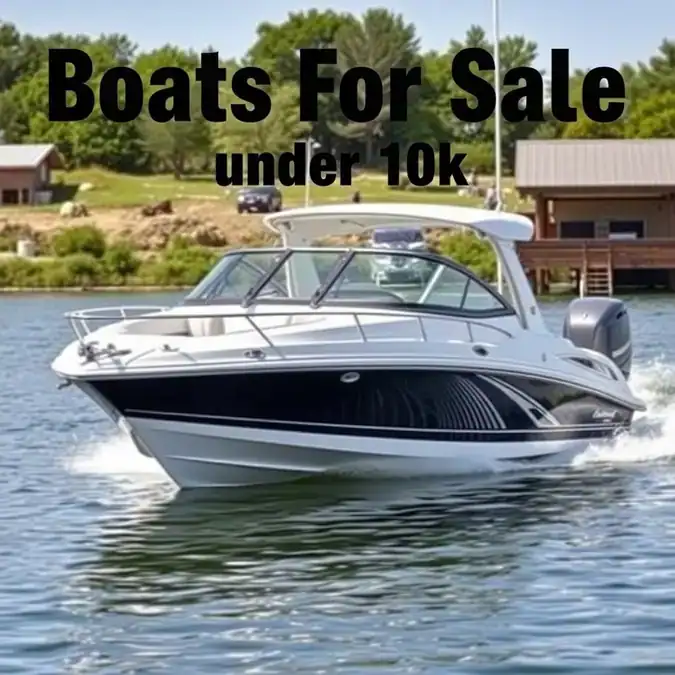
Boats for Sale Under 10k
I was standing on a dusty dock in Florida last spring, wallet in hand, realizing my “dream boat” budget had a hard ceiling at ten grand. Then I discovered boats for sale under 10k aren’t just beat-up hulls — they’re legitimate fishing platforms, weekend cruisers, and learning tools that get you on the water without a second mortgage.
- You can get on the water for under $10,000 — no financing, no monthly payments, just cash and keys.
- Small boats teach big skills — handling, maintenance, navigation, and weather reading all transfer up.
- Jon boats, aluminum skiffs, and older fiberglass runabouts dominate this price range — each has a sweet spot.
- Inspect the transom, floor, and lower unit before you buy — those three areas eat budgets fast.
- Trailer condition matters as much as the hull — a bad trailer strands you before you launch.
- Insurance, registration, and safety gear add $500–$1,500 — budget for them upfront.
Introduction

I was struggling with the idea that real boating required a $40,000 bass boat or a $60,000 center console. Then I discovered boats for sale under 10k and everything changed. My first purchase was a 1996 16-foot aluminum jon boat with a 25-horse Mercury — $3,200 cash, trailer included. That little rig taught me more about water, wind, and fish than any glossy brochure ever could.
You don’t need deep pockets to start boating. You need patience, a flashlight, and a willingness to look past faded gelcoat. This guide walks through every angle — what’s out there, how to pick a winner, what to fix first, and how to stretch every dollar. I’ve bought, sold, repaired, and fished from half a dozen sub-$10k boats. The lessons are real. The savings are real. Let’s get you on the water.
Why Use boats for sale under 10k

The biggest reason is simple: access. A $7,000 boat gets you to the same fishing spots, the same sandbars, the same sunsets as a $70,000 boat. Water doesn’t check your bank statement. When I talk to newcomers, I hear the same fear — “I’ll look cheap.” Nobody on the water cares. They care if you know the channel markers, if you yield to sailboats, if you pick up your trash.
Low-cost boats also remove the fear of scratches. Bang a dock with a financed bay boat and your stomach drops. Bang a dock with a $4,500 jon boat and you grab a hammer. That freedom lets you explore skinny water, beach on oyster bars, and learn by doing. Mistakes become tuition, not tragedy.
There’s also the ownership math. No loan means no interest, no full-coverage insurance requirement, no lienholder telling you where to store it. You own it outright. That changes how you feel about the hobby — it’s yours, not the bank’s.
Benefits of Using boats for sale under 10k

Cash ownership tops the list. You walk away with a title in hand. That means lower insurance — often just liability at $150–$300 a year. It means you can park it behind the shed, under a tarp, and nobody sends threatening letters.
Maintenance costs stay lower too. Smaller engines burn less fuel. A 25-hp four-stroke sips 1.5 gallons an hour at cruise. My buddy’s 250-hp offshore rig drinks 18. Over a 50-hour season, that’s $1,200 vs. $14,000 at $4 gas. The math compounds fast.
Trailering gets easier. Most sub-10k boats sit on single-axle trailers you can pull with a midsize SUV or even a V6 sedan. No CDL, no wide-load mirrors, no white-knuckle mountain passes. Launch ramps welcome you. Marinas charge less for slip space.
Depreciation? Already happened. The previous owners ate the steep curve. If you maintain it, you’ll likely sell for what you paid. I’ve flipped three budget boats and never lost money — once I made $800 after two seasons.
Finally, the community. Budget boaters share tips, spare parts, and ramp beers. There’s a camaraderie at the $5 launch fee crowd that you don’t always find at the yacht club.
Types of boats for sale under 10k

Three main categories own this price bracket. Aluminum jon boats and utility skiffs lead the pack — 12 to 18 feet, flat or mod-V bottoms, bare bones or rigged with consoles. They’re light, tough, and parts are everywhere. A 16-foot tracker with a 40-hp might list at $8,500.
Older fiberglass runabouts and bowriders fill the 17–21 foot range. Think 1990s Bayliners, Four Winns, Stingrays. They offer cushions, windshields, and stereo systems — but watch for soft floors, rotten stringers, and tired outdrives. A clean 1995 18-foot bowrider with a 4.3L V6 can sit right at $9,500.
Small center consoles and fish-and-ski models round out the mix. 15–17 foot hulls from brands like Carolina Skiff, Sea Chaser, or older Mako/Century models. They fish well, handle chop better than flat-bottoms, and often come with livewells and rod holders. Prices cluster $7,000–$10,000 for 1990s–early 2000s examples.
Inflatables and RIBs sometimes appear — 10–12 foot Zodiacs or Avons with 15–25 hp outboards. Great tenders, limited range. Kayaks and micro-skiffs (like the Gheenoe) sit at the bottom end — $1,500–$4,000 — for solo anglers in protected water.
Popular Types of boats for sale under 10k
Jon boats rule the shallow-water kingdom. Flat bottom, squared bow, bench seats. A 14-footer with a 15-hp pushes two adults and gear at 18 mph. Add a poling platform and you’re a flats guide. I’ve seen 16-foot welded alumawelds with 40-hp four-strokes sell for $6,500 — turnkey duck boats.
Mod-V aluminum skiffs (like Crestliner, Lowe, Smoker Craft) add a slight deadrise for chop. They track straighter, handle wind better, and still draft 6 inches. A 1650 mod-V with a 50-hp and console runs $8,000–$9,500 used. That’s a serious walleye or bass rig.
V-hull runabouts — the classic “family boat” — give dry rides and storage. Bow seating, glove boxes, swim platforms. The tradeoff: deeper draft, heavier trailer, outdrive maintenance. A 1998 Four Winns 180 Horizon with a 4.3L Alpha One listed locally at $8,900 last month. Clean interior, new bimini.
Micro center consoles (15–17 feet) punch above their weight. Carolina Skiff 178 DLV, Sea Chaser 16 HFC, older Key West 156. Open decks, self-bailing, center steering. They take 2–3 foot chop if you slow down. Prices hover $7,500–$10,000 for 1990s–2000s models with 70–90 hp.
Don’t sleep on sailboats. A 1970s Catalina 22 or O’Day 22 with trailer lists $3,000–$6,000. Fixed keel or swing keel, cabin for two, diesel auxiliary. Learning curve is steeper but operating cost is near zero. I know a guy who sails his $4,200 Catalina every weekend April through October.
How to Choose boats for sale under 10k
Start with water type. Protected lakes and rivers? Flat-bottom jon or micro-skiff. Big lakes, bays, nearshore ocean? Mod-V or small V-hull. Offshore? Save longer — this budget won’t buy safe bluewater.
Count passengers honestly. Two anglers plus dog? 16-foot minimum. Family of four? 18-foot bowrider or deck boat. Solo? 12-foot jon or kayak-skiff hybrid.
Match horsepower to hull. Overpowering a light aluminum hull creates porpoising and stress cracks. Underpowering a heavy fiberglass boat makes planing a struggle. Check the capacity plate — it’s law, not suggestion.
Trailer first, boat second. Lights work? Tires hold air? Bearings spin free? Frame straight? Brakes (if equipped) function? A $1,200 trailer rebuild kills a “great deal” fast. I once passed a $5,000 boat because the trailer needed $1,800 in axles and bunks. Bought a $6,500 boat with a perfect trailer instead. Best decision.
Engine hours matter less than maintenance records. A 300-hour motor with annual oil changes beats a 100-hour motor that sat three winters fogged. Pull the cowling. Look for corrosion, salt crust, cracked hoses. Compression test if you can. Lower unit oil should be honey-clear, not milky.
Installation and Setup of boats for sale under 10k
Day one: safety gear. Coast Guard minimum — life jackets (Type II or III, one per person), throwable Type IV, fire extinguisher (B-I), visual distress signals (day/night), sound device (horn/whistle), navigation lights. Add a VHF radio ($120), first-aid kit, anchor with 100 ft rode, and bailer. Total ~$400.
Register the boat and trailer in your state. Title transfer, sales tax, decals. Budget $150–$400 depending on location. Some states require boater safety cards — take the free online course.
Electronics: a $150 GPS/chartplotter (Garmin Striker 4) and transducer mounts in 20 minutes. Fishfinder saves fuel finding structure. Phone mount with waterproof case handles navigation backup.
Trolling motor? 12V 45-lb thrust on jon boats, 24V 70-lb on 16+ footers. Minn Kota Endura C2 45-lb runs $230. Mount on bow with quick-release bracket. Deep-cycle battery ($110) in a box strapped to floor.
Livewell pump ($40) and timer ($15) if the boat lacks one. Drill one 1-1/8″ hole, wire to switch panel. Keeps bait alive all day.
Canvas: bimini top ($180) for sun, mooring cover ($120) for storage. Measure twice, order once. Snaps install with a $25 tool.
Tips for Using boats for sale under 10k Effectively
Learn the ramp. Backing a trailer is a skill — practice in an empty parking lot. Use your mirrors, go slow, small corrections. I still put a hand at the bottom of the wheel; it reverses the steering logic naturally.
Trim is your friend. Trim up for shallow water, hole shot, and porpoising fix. Trim down for chop, tracking, and fuel economy. Listen to the prop — ventilation sounds like a buzzsaw. Trim down until it bites.
Fuel management: ethanol-free gas if you can find it. Stabilizer (Star Tron) every fill. Run the engine dry before storage >2 weeks. Carbureted two-strokes? Fog the cylinders. Four-strokes? Change oil annually regardless of hours.
Wash after every salt trip. Freshwater flush 10 minutes. Soap the hull, wax twice a year. Aluminum gets Aluma-Bright or vinegar wash for oxidation. Cover the boat — UV destroys gelcoat, vinyl, and tires.
Build a “ramp kit” — ratchet straps, spare plug, multitool, headlamp, zip ties, duct tape, spare bulbs, funnel, oil, lower unit lube. Lives in the tow vehicle. Saves trips home.
File a float plan. Text a friend: launch ramp, destination, return time, boat description. Takes 30 seconds. Could save your life.
How It Works for Me
My current rig is a 2001 16-foot Lund 1600 Pro-V with a 60-hp Mercury four-stroke. Paid $8,700 including a galvanized trailer with disc brakes. I fish the St. Johns River and nearby lakes 40+ times a year.
Morning routine: check oil, tilt motor down, pump bilge, verify drain plug. Load rods, tackle, cooler, anchor. Back down the ramp, float off, park truck. Total launch time: 6 minutes solo.
On plane at 32 mph burning 3.2 gph. Trolling motor runs 6 hours on one Group 27 battery. I’ve hit submerged logs, oyster bars, and one very surprised manatee. The aluminum hull shows dents, not cracks. Repair is a hammer and dolly, not a fiberglass shop.
Winter storage: motor tilted down, fuel stabilized, battery on tender, cover strapped tight. Spring commissioning: oil change, lower unit lube, impeller every other year, test run. $120 in parts, 2 hours labor.
This boat pays for itself in fish, sunsets, and quiet mornings. No payment coupon arrives in the mail. That feeling never gets old.
What I Like
Freedom from debt. I sleep better knowing no bank owns my recreation. The cash purchase forced discipline — I saved, I searched, I negotiated. The boat feels earned.
Simplicity. No complex systems to fail. No generator, no air conditioning, no hydraulic steering, no touchscreen dash. When something breaks, I fix it with hand tools and YouTube. That self-reliance bleeds into other parts of life.
Versatility. This Lund fishes bass at dawn, pulls a tube at noon, anchors at a sandbar for lunch, runs home before storms. One hull, three missions. Bigger specialized boats do one thing well.
Community. Ramp conversations start with “What’re you running?” not “What do you do?” Strangers become fishing partners. I’ve learned more from 15-minute dock talks than years of magazines.
Resale resilience. Clean it, maintain it, document it. The next buyer gets a known quantity. I keep a binder — receipts, oil change dates, impeller swaps, compression logs. It sells the boat before the sea trial.
What Could Be Better
Rough water beats you up. No cushion, no deadrise, no mass to absorb chop. 2-footers at 25 mph feel like a jackhammer. I slow down, quarter the waves, accept the wet ride. It’s the physics of 1,100 pounds.
Wind pushes you. High sides act like sails. Docking solo in 15 mph crosswind takes practice — and sometimes a neighbor’s helping hand. Bow thruster? Not in this budget. Spring lines and patience.
Storage is tight. Two tackle boxes, safety gear, anchor, cooler, life jackets — the deck disappears. I added under-gunwale trays and a bow locker divider. Still, pack light.
No head. Portable toilet in a bucket under the console works, but it’s not civilized. Day trips only unless you’re creative.
Resale pool is smaller. Buyers want financing. Cash buyers are rare. I list on three platforms, take 20 photos, write honest descriptions. Still takes 30–60 days.
My Personal Experience
First boat: 1988 14-foot Tracker Grizzly jon, 15-hp Johnson two-stroke, $1,800. Leaked at the rivets. I drilled them out, bucked solid rivets with a hammer and bucking bar — $12 in rivets, weekend of work. Dry as a bone after. Caught my first 5-lb bass from that boat.
Second: 1995 17-foot Bayliner Capri, 4.3L V6 Alpha One, $4,200. Pretty. Comfortable. Soft spot in the floor forward of the console. I ignored it. Six months later the floor gave way. $1,400 in marine ply, resin, and weekends. Sold it for $3,800 — lesson learned.
Third: 2003 15-foot Gheenoe Highsider, 20-hp Honda four-stroke, $3,500. Pole skiff perfection. Drafted 4 inches. Poled redfish flats, snuck up on tailing bonefish. Sold to a guide who needed a backup — he paid $4,000.
Fourth: current Lund. Bought from a meticulous retired engineer. Maintenance log went back to 2001. Compression 115 psi across all cylinders. Trailer bearings repacked annually. I’ve added a Garmin 73sv, Minn Kota Terrova 55, and LED nav lights. Still under $10k total.
Each boat taught me something. The jon taught rivets. The Bayliner taught floors. The Gheenoe taught stealth. The Lund teaches confidence. The next one? Maybe a 19-foot center console. But I’ll pay cash.
Recommendation
If you’re new to boating, start with a 14–16 foot aluminum jon or mod-V with a 25–40 hp four-stroke. It’s the most forgiving platform — stable, shallow, simple, durable. Brands: Tracker, Lowe, Crestliner, Alumacraft, G3. Look for welded seams, not riveted, if budget allows.
If you have experience and want comfort, target a 1990s–2000s 18-foot bowrider with a 4.3L V6. Sea trial it hard. Check the transom assembly, gimbal bearing, bellows, U-joints. Budget $1,500 for immediate outdrive service if records are missing.
If fishing is the sole mission, hunt a 16–17 foot micro center console. Carolina Skiff, Sea Chaser, Key West, Mako. Open deck, self-bailing, center helm. Verify the hull-to-deck joint — no cracks, no water in the foam.
Whatever you choose, bring a marine surveyor for anything over $5,000. $300–$500 saves thousands. I skipped it once. Never again.
How to Use boats for sale under 10k Effectively
Define your water. Be honest. 90% of my time is protected river. My boat matches that. If you chase kingfish 20 miles out, this budget is dangerous.
Set a total budget — boat, trailer, safety gear, electronics, registration, insurance, first service. My rule: boat price × 1.3 = real cost. $7,000 boat = $9,100 out the door.
Search daily. Facebook Marketplace, Craigslist, Boat Trader, OnlyInboards, local marina bulletin boards. Set alerts. The best deals last 48 hours. I found my Lund at 6:47 AM, called at 6:50, saw it at noon, bought it at 2 PM.
Inspect systematically. Hull, transom, floor, stringers, motor, lower unit, trailer, title. Checklist on phone. Photos of everything. Cold engine start — listen for knocks, watch for smoke, feel for vibration.
Negotiate from data. “Compression is 115, spec is 120. Lower unit oil was milky. Trailer tires are 2018 date codes.” Facts beat feelings. Cash in hand talks.
Close at a tag office or bank. Verify title matches HIN. Sign bill of sale. Get keys, registration, manuals. Drive away legal.
boats for sale under 10k Alternatives
Charter memberships — Freedom Boat Club, Carefree Boat Club. $3,000–$5,000 initiation, $300–$500/month. Access to fleets, no maintenance. Good for urbanites with storage limits. You build zero equity.
Boat sharing — Boatsetter, GetMyBoat. Peer-to-peer rental. $150–$400/day. Try before you buy. Insurance included. No equity, no customization, scheduling friction.
Kayak fishing — $800–$2,500 for pedal-drive fishing kayaks (Hobie, Old Town, Bonafide). Incredible access, zero fuel, car-top transport. Limited range, exposure, physical demand. I keep a kayak for solo mornings.
Jon boat kits — Alumacraft, G3, and others sell hull-only kits $2,500–$4,000. You add motor, trailer, rigging. Total often lands $7,000–$9,000. Custom build satisfaction, but time-intensive.
Fractional ownership — split a $30,000 boat four ways. $7,500 each, shared calendar, shared costs. Requires ironclad agreement and compatible partners. I’ve seen friendships end over fuel logs.
My Personal Recommendation
For most people starting out, a used 16-foot welded aluminum mod-V with a 40-hp four-stroke and a galvanized bunk trailer is the sweet spot. It fishes shallow, handles chop, sips gas, trails behind a crossover, and sells fast when you’re ready to step up. Brands like Lowe, Crestliner, and Tracker flood the used market — parts and knowledge are everywhere.
If you’re ready to search today, start with Boat Trader’s under-$10k listings filtered to your zip code. Save searches, set alerts, and be ready to move fast. The right boat at the right price doesn’t wait.
Quick Comparison Table
| Feature | 16′ Aluminum Mod-V + 40 HP | 18′ Fiberglass Bowrider + 4.3L | 17′ Micro Center Console + 90 HP |
|---|---|---|---|
| Typical Price | $6,500–$9,000 | $7,500–$10,000 | $8,000–$10,000 |
| Draft (inches) | 6–8 | 28–32 (drive down) | 12–14 |
| Fuel Burn (gph) | 2.5–3.5 | 5–7 | 4–6 |
| Max Passengers | 3–4 | 6–7 | 4–5 |
| Chop Handling | Fair | Good | Good |
| Maintenance Complexity | Low | Medium-High | Medium |
| Best For | Rivers, lakes, flats | Big lakes, family cruising | Bays, nearshore, serious fishing |
FAQs
What is the best boat for sale under 10k?
A 16-foot welded aluminum mod-V with a 40-hp four-stroke offers the best balance of versatility, durability, and low operating cost for most beginners.
How much does a boat for sale under 10k cost to own annually?
Expect $800–$1,500 per year for insurance, registration, fuel, maintenance, and storage — far less than financed boats.
What should I look for when buying a boat for sale under 10k?
Check the transom, floor, stringers, lower unit oil, compression, trailer bearings, and title status. Hire a surveyor for purchases over $5,000.
Can I finance a boat for sale under 10k?
Most lenders won’t finance boats under $10,000 or older than 15–20 years. Cash is king in this bracket.
Are boats for sale under 10k safe for ocean use?
Only small center consoles with self-bailing decks and adequate freeboard — and only in calm conditions with experience. Most sub-$10k boats are inshore craft.
How do I register a boat for sale under 10k?
Take the signed title, bill of sale, and ID to your state’s DMV or wildlife agency. Pay sales tax and registration fees. Receive decals and registration card.
What maintenance does a boat for sale under 10k need?
Annual oil change, lower unit lube, impeller every 2 years, fuel stabilizer, battery care, hull wash/wax, trailer bearing repack, safety gear inspection.
Can I live aboard a boat for sale under 10k?
Not practically. Sub-$10k boats lack heads, holding tanks, shore power, and living space. Look at 27+ foot sailboats for liveaboard budgets.
Conclusion
Ten thousand dollars buys a legitimate ticket to the water. Not a compromise — a choice. My $8,700 Lund has delivered more mornings of glass-calm water, more bass, more laughs with my kids, and more peace than any payment plan could finance. The boats are out there. The knowledge is free. The ramp is open. Your move.