
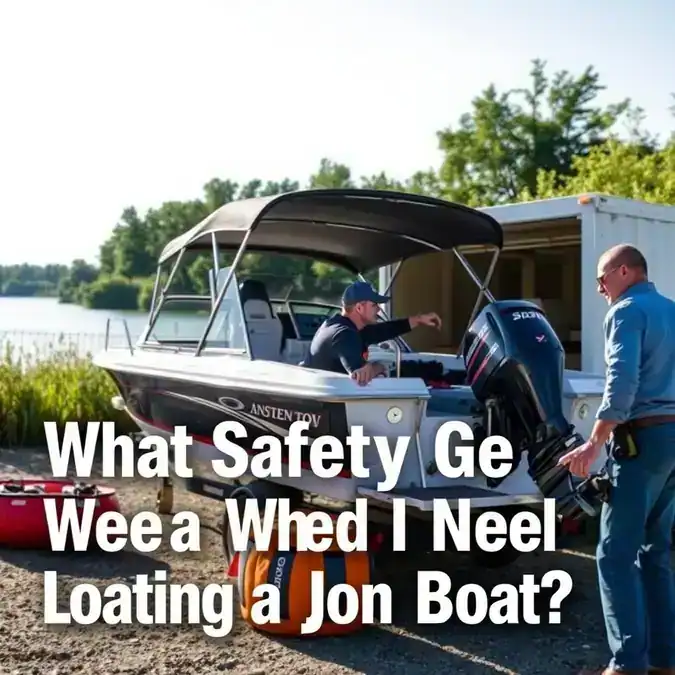
What Safety Gear Do I Need When Loading a Jon Boat?
I was struggling with figuring out exactly what safety gear I needed every time I backed my jon boat down a slick ramp at dawn. Then I discovered a simple checklist system that changed everything. Loading a jon boat solo or with a buddy shouldn’t feel like a gamble. You need the right gear, the right habits, and a plan that works when the water is cold and the dock is crowded. This guide walks through every piece of safety equipment you need, why it matters, and how to use it without overcomplicating your morning routine.
- Wear a USCG-approved life jacket before you step on the trailer — not after you’re in the boat.
- Non-slip footwear and gloves prevent the most common loading injuries: slips, pinched fingers, and back strains.
- A bow line, stern line, and trailer winch strap form the three-point control system that keeps the boat from sliding off sideways.
- Lighting, a whistle, and a throwable flotation device meet federal requirements and buy you time if something goes wrong.
- Practice your loading routine at a quiet ramp before you try it in wind, current, or low light.
Key Takeaways

Introduction

Early mornings at the boat ramp teach you fast. I learned the hard way when my boots slipped on algae-slick concrete and my jon boat drifted sideways off the trailer — me hanging on the bow cleat, heart pounding, water up to my knees. That day I realized what safety gear do I need when loading a jon boat isn’t a theoretical question. It’s the difference between a good fishing story and a rescue call. Over twenty seasons of hauling aluminum hulls in and out of reservoirs, rivers, and farm ponds, I’ve boiled it down to a handful of non-negotiables and a few smart upgrades. This article shares that list, explains why each item earns its spot, and shows you how to put it all together into a repeatable routine you can trust.
Why Use What Safety Gear Do I Need When Loading a Jon Boat?

Jon boats sit low, float light, and have flat bottoms that slide on trailers like hockey pucks on ice. Add a steep ramp, a crosswind, or a solo loader, and the physics turn against you fast. The U.S. Coast Guard reports that loading and unloading accidents account for a surprising share of non-collision boating injuries — crushed fingers, back injuries, and drownings when someone falls between boat and dock. Proper gear does three things: it keeps you attached to the boat, it gives you mechanical advantage so you’re not muscling a 400-pound hull, and it satisfies the legal minimums so a warden’s checklist doesn’t ruin your day. Think of it like a seatbelt — you don’t wear it because you plan to crash. You wear it because the ramp doesn’t care about your plans.
Benefits of Using What Safety Gear Do I Need When Loading a Jon Boat?
The payoff shows up in three places: your body, your boat, and your peace of mind. First, non-slip deck shoes and cut-resistant gloves stop the everyday hurts — skinned knuckles from winch handles, twisted ankles on wet bunks, lower-back tweaks from yanking a stuck trailer. Second, a properly tensioned winch strap and bow/stern lines keep the hull centered, preventing gelcoat cracks, bent rub rails, and the nightmare of a boat sliding off sideways into the water with the motor still trimmed down. Third, legal compliance. Most states follow USCG minimums: one wearable PFD per person, a throwable Type IV device on boats 16 feet and over, a sound-producing device, and navigation lights if you’re loading before sunrise or after sunset. Check your state’s boating handbook — some add a fire extinguisher requirement for any boat with an enclosed fuel tank or permanent engine installation. The gear pays for itself the first time you load alone in a 15-knot crosswind and everything stays where it belongs.
Types of What Safety Gear Do I Need When Loading a Jon Boat?
Group the gear into four buckets: personal protection, boat control, legal compliance, and situational upgrades. Personal protection means a Type III or Type V life jacket you’ll actually wear — not the orange horseshoe gathering dust in the console. Add deck boots with siped rubber soles, cut-resistant gloves (ANSI A4 or better), and polarized glasses so you can see the trailer bunks through glare. Boat control gear centers on the three-point tie-down: a rated winch strap with a hook that won’t straighten under load, a 15-foot bow line with a float, and a 10-foot stern line. Legal compliance adds a Type IV throwable cushion or ring, a pealess whistle clipped to your PFD, and working nav lights (red/green bow, white stern). Situational upgrades depend on your ramp: a handheld spotlight for pre-dawn loads, a trailer guide pole set for windy days, and a waterproof VHF radio if you’re on big water where cell service dies. Each bucket solves a different failure mode. Skip one and you’ve left a hole in the system.
Popular Types of What Safety Gear Do I Need When Loading a Jon Boat?
Walk any busy ramp and you’ll see patterns. Most jon boat anglers wear inflatable belt-pack PFDs (Type V) because they stay cool and don’t restrict casting motion — brands like Onyx and Mustang Survival dominate. For footwear, Xtratuf deck boots and Sperry Top-Sider Xtra Tuffs lead the pack; both drain fast and grip wet aluminum. Glove-wise, Mechanix Wear M-Pact and Ironclad EXO Motor series show up constantly — they take winch abuse and still let you tie a cleat hitch. Winch straps: Fulton and Dutton-Lainson 2-inch polyester straps with forged hooks are the standard. Bow/stern lines: 3/8-inch double-braid nylon with a thimble eye and a small float — Yale Cordage and New England Ropes make the good stuff. Throwable devices: the classic orange Type IV cushion (Kwik Tek or Jim Buoy) or a horseshoe buoy with a 60-foot line. Whistles: Fox 40 Classic or Storm — pealess, loud, works wet. Nav lights: Attwood LED combos or Perko plug-in bases with LED bulbs. These aren’t endorsements — they’re what survives the ramp test of time.
How to Choose What Safety Gear Do I Need When Loading a Jon Boat?
Match the gear to your boat, your body, and your ramp. Start with the PFD: if you’re over 250 pounds or run a big motor, check the buoyancy rating — some inflatables only rate to 22.5 pounds. Try it on over your heaviest jacket. Sit in the driver’s seat. Can you turn your head? Reach the tiller? If not, size up or switch styles. Footwear: size for wool socks in November. Gloves: measure your hand circumference at the knuckles — too tight cuts circulation, too loose catches on winch gears. Winch strap: match the working load limit to your boat’s wet weight (hull + motor + fuel + gear). A 14-foot jon with a 25 hp four-stroke runs ~600 pounds wet; get a strap rated at least 1,500 pounds WLL. Lines: 3/8-inch nylon stretches 15-20% under load — that shock absorption saves cleats. Length: bow line should reach from cleat to your hand standing on the dock; stern line from transom cleat to your hand at the trailer fender. Throwable: Type IV cushion for small boats, horseshoe with line for anything over 16 feet or big water. Lights: LED draws less amperage, lasts seasons longer, and survives submersion better than incandescent. Buy once, cry once — cheap gear fails when you need it most.
Installation and Setup of What Safety Gear Do I Need When Loading a Jon Boat?
Gear does nothing in the garage. Mount the winch strap so the hook pulls straight — no side loading the trailer winch post. Thread the strap through the bow eye, not over the rub rail. Keep the winch handle stowed but reachable. Bow line: splice a thimble eye, add a float 3 feet from the clip so it doesn’t sink and snag the prop. Store coiled in a mesh bag on the bow deck. Stern line: same treatment, clipped to the transom cleat. PFD: wear it. Don’t stow it. Whistle: clip to the PFD shoulder strap with a mini carabiner. Throwable: mount the cushion in a dedicated bracket on the gunwale — not loose on the floor. Nav lights: test before every trip. Bow light plugs into the base at the stem; stern light on a 24-inch pole at the transom. Carry spare bulbs and a 10-amp fuse in the console. Trailer guide poles: bolt to the trailer frame, not the fenders. Adjust so the inner edges are 2 inches wider than your hull at the chine. Spotlight: Velcro mount on the dash, plug into 12V outlet. VHF: flush-mount or bracket-mount near the helm, antenna on the highest point. Do a dry run in the driveway. Walk through the whole load sequence. Fix what snags.
Tips for Using “What Safety Gear Do I Need When Loading a Jon Boat?” Effectively
Routine beats heroics. Same order every time: 1) PFD on, whistle clipped. 2) Boat prepped — drain plug in, motor trimmed up, gear stowed, lines coiled and ready. 3) Back trailer until bunks are just covered — you want the boat to float onto the last foot of bunk, not slam the transom. 4) Bow line first. Step on the dock, clip the bow line to the dock cleat with a cleat hitch. Leave slack. 5) Winch strap. Hook the bow eye. Crank until snug — not guitar-string tight. 6) Stern line. Walk back, clip to dock cleat. Snug both lines. 7) Kill the vehicle, set parking brake, chock wheels. 8) Unhook safety chain, lower motor, start engine. 9) Release stern line, then bow line. 10) Idle away. Reverse for loading. Solo? Use a long bow line you can reach from the driver’s seat. Tie it to the trailer winch post, drive the boat on, hop out, winch it home. Wind? Approach upwind. Current? Approach up-current. Night? Headlamp plus spotlight — never just headlamp. Practice until it’s boring. Boring is safe.
How It Works for Me
My setup is a 14-foot Tracker Grizzly with a 25 hp Mercury four-stroke on a galvanized bunk trailer. I load alone 80% of the time. PFD: Onyx A/M-24 inflatable belt pack — forget I’m wearing it. Boots: Xtratuf Legacy 12-inch, sized for heavy socks. Gloves: Mechanix M-Pact 3, size large. Winch: Fulton 2-speed with 20-foot 2-inch strap, 2,600 lb WLL. Bow line: 20-foot 3/8-inch double-braid with thimble and float. Stern line: 15-foot same. Throwable: Kwik Tek Type IV cushion in a gunwale bracket. Whistle: Fox 40 on PFD. Lights: Attwood LED bow/stern combo. Guide poles: CE Smith galvanized, bolted to frame. Spotlight: Streamlight Waypoint rechargeable. VHF: Standard Horizon HX890 handheld with DSC. Routine takes three minutes flat. I’ve loaded in 25 mph gusts on Lake Erie, in pouring rain on the Ohio River, at 4:30 a.m. on a farm pond with no dock — just mud bank. The gear holds. The routine holds. I go fishing instead of fighting the ramp.
What I Like
The inflatable PFD disappears until you need it. The 2-speed winch lets me crank fast on the first gear, then switch to low gear for the final pull — saves my shoulder. Double-braid nylon lines stretch just enough to absorb the surge when a wake hits while you’re tied to the dock. Guide poles turn a 20-minute wind fight into a 90-second straight-in. The handheld VHF means I can call the marina for a slip or the Coast Guard if the motor quits — without digging for a phone with wet hands. The spotlight throws 1,000 lumens 500 meters — I can see the bunk edges at 5 a.m. in fog. Everything has a home. Nothing rattles. Nothing gets lost. The system scales: same routine works for my buddy’s 16-foot Lund, my dad’s 12-foot alumacraft. Muscle memory is the real safety gear.
What Could Be Better
Inflatable PFDs need annual inspection — pull the cord, check the cylinder, repack. I’ve skipped a year. Don’t. The belt pack rides high on my hips; a vest-style might sit better for some body types. Guide poles rattle on rough roads — a rubber grommet at the base fixes it. The handheld VHF battery lasts a long day but not a weekend without a charge — carry a USB power bank. Spotlight gets hot on high; the mounting Velcro can loosen — screw mount is better. Winch strap frays at the hook after two seasons — inspect before every trip. Bow line float degrades in UV — replace annually. None of these are dealbreakers. They’re maintenance items. The gear works if you maintain it.
My Personal Experience
Last November on the Muskingum River. Water 42 degrees. Ramp iced at the edges. Wind 18 mph quartering across the channel. I backed in, bow line ready. Boat floated onto bunks clean. Winch strap hooked. First gear — whir, whir, whir. Second gear — slow, steady, solid. Stern line clipped. Motor down. Started first pull. Released lines. Idled to the dock. Hands warm. Heart rate normal. Three years earlier, same ramp, no guide poles, no bow line pre-rigged. Boat slid sideways. I jumped. Wet to the waist. Motor trimmed down — prop hit the trailer. $1,200 repair. Missed the whole day. That’s the tuition. The gear cost maybe $400 total. Do the math. The ramp doesn’t give second chances. But it respects preparation.
Recommendation
Start with the non-negotiables: USCG-approved PFD you’ll wear, non-slip boots, cut-resistant gloves, rated winch strap, bow and stern lines, Type IV throwable, whistle, working nav lights. That’s your baseline. Legal, functional, life-saving. Add guide poles if your ramp sees wind. Add spotlight if you load in darkness. Add VHF if you’re on water bigger than a section line. Buy quality once. Practice until it’s automatic. Teach your kids. Teach your buddies. The best safety gear is the system you actually use.
How to Use What Safety Gear Do I Need When Loading a Jon Boat? Effectively
Effective use means muscle memory under stress. Drill the sequence: PFD, lines, winch, motor, go. Practice at a quiet ramp on a Tuesday afternoon. Time yourself. Three minutes is the target. Add complications: gloves on, headlamp only, one-handed (simulate holding a coffee — kidding, don’t hold coffee). Practice solo loading with a long bow line tied to the trailer winch post. Practice recovering a boat that slipped off-center — use the winch to pull it straight, not your back. Practice throwing the Type IV cushion — underhand, into the wind, at a target 30 feet away. Practice the VHF mayday call: “Mayday, mayday, mayday, this is [boat name], [location], [nature of emergency], [number of persons], over.” The Coast Guard recommends monthly drills. I do quarterly. Better than never. The goal: when the ramp goes sideways, your hands know what to do while your brain catches up.
What Safety Gear Do I Need When Loading a Jon Boat? Alternatives
Some gear has valid substitutes. PFD alternative: inherently buoyant Type III vest (NRS Chinook, Stohlquist Fisherman) — no maintenance, runs hotter, restricts motion less than cheap foam vests. Boot alternative: Simms Flyweight boots with Vibram soles — lighter, drain faster, less ankle support. Glove alternative: Glacier Glove Ice Bay — neoprene, warm, grippy, less cut resistance. Winch strap alternative: synthetic rope (Dyneema/Spectra) — lighter, no stretch, but UV sensitive and cuts easier on sharp edges. Line alternative: 1/2-inch three-strand nylon — cheaper, more stretch, harder to coil, hocks worse. Throwable alternative: horseshoe buoy with 60-foot line — better for man overboard, bulkier to store. Light alternative: portable suction-cup LED nav lights (Navisafe) — good for boats without permanent wiring, easy to steal or lose. Whistle alternative: any pealess whistle — Fox 40, Storm, Acme — all work. VHF alternative: PLB (Personal Locator Beacon) like ACR ResQLink — satellite alert, no two-way comms, subscription-free. Choose based on your water, your budget, your honesty about what you’ll actually maintain.
My Personal Recommendation
If you buy one upgrade this season, make it the guide poles. CE Smith galvanized set, bolted to the trailer frame, adjusted to your hull. They turn the hardest part of loading — centering the boat in wind or current — into a non-event. Pair them with a 2-speed winch and pre-rigged bow/stern lines. That trio covers 90% of loading scenarios. The PFD, boots, gloves, throwable, whistle, and lights are the foundation — don’t launch without them. But the guide poles, 2-speed winch, and pre-rigged lines are the force multipliers. They make solo loading feel easy. And when loading feels easy, you do it right every time. Check current prices on CE Smith guide poles and see what fits your trailer.
Quick Comparison Table
| Feature | Inflatable Belt PFD | Type III Foam Vest | Type V Hybrid |
|---|---|---|---|
| Comfort (all day) | Excellent | Good | Very Good |
| Maintenance | Annual cylinder check | None | Annual check |
| Buoyancy | 22.5-35 lbs | 15.5-22 lbs | 22-35 lbs |
| Cost Range | $80-$160 | $40-$100 | $100-$180 |
| Best For | Active anglers, heat | Cold water, kids, low maintenance | Versatility, paddle sports |
| Feature | 2-Speed Winch + Strap | Single-Speed Winch + Strap | Electric Winch |
|---|---|---|---|
| Effort (loaded boat) | Low | High | Minimal |
| Reliability | Very High | Very High | Moderate (motor/battery) |
| Cost Range | $60-$120 | $35-$70 | $180-$350 |
| Maintenance | Grease gears annually | Grease gears annually | Motor, wiring, battery |
| Best For | Most jon boats, solo loaders | Light boats, budget builds | Heavy boats, physical limits |
| Feature | Guide Poles (Bolt-On) | Guide Poles (Clamp-On) | No Guide Poles |
|---|---|---|---|
| Wind Resistance | Excellent | Good | Poor |
| Install Time | 30 min | 10 min | N/A |
| Durability | High | Moderate | N/A |
| Cost Range | $40-$80 | $30-$60 | $0 |
| Best For | Permanent setup, windy ramps | Shared trailers, rentals | Calm water, wide bunks |
FAQs
What is the minimum safety gear required when loading a jon boat?
USCG minimums: one wearable PFD per person, Type IV throwable on boats 16+ feet, sound device (whistle), navigation lights if loading in darkness. State laws may add fire extinguisher, registration, and education card.
Do I need to wear a life jacket while loading the boat?
Yes. Most drowning victims at ramps never intended to be in the water. Wear the PFD before you step on the trailer. Inflatable belt packs make this easy.
What size winch strap do I need for a 14-foot jon boat?
Match the working load limit to 2.5x your boat’s wet weight. A typical 14-footer with motor and gear weighs ~600 lbs wet — choose a strap rated 1,500+ lbs WLL. 2-inch polyester is standard.
Can I use rope instead of a winch strap?
Not for the primary winch connection. Rope stretches, degrades in UV, and can slip on the winch drum. Use a rated polyester winch strap for the bow eye. Rope is fine for bow/stern dock lines.
How often should I replace my bow and stern lines?
Inspect before every trip. Replace at first sign of chafe, UV fuzz, stiff sections, or cut strands. For weekend warriors, annually is cheap insurance. Double-braid nylon lasts 2-3 seasons with care.
Are trailer guide poles worth it?
Absolutely. They center the hull automatically in wind and current. Bolt-on models are more durable than clamp-on. Adjust them 2 inches wider than your chine. Best $50 you’ll spend on the trailer.
What’s the best footwear for loading a jon boat?
Deck boots with siped rubber soles (Xtratuf, Sperry Xtra Tuff) or amphibious hiking shoes (Merrell Hydro Moc, Astral Loyak). Avoid flip-flops, Crocs, or smooth-soled sneakers — they slip on wet bunks.
Do I need a VHF radio for a small jon boat?
On big water (Great Lakes, large reservoirs, coastal), yes — cell service fails. On small inland lakes with good coverage, a phone in a waterproof case works. PLB is a solid backup for solo boaters anywhere.
How do I load a jon boat solo in high wind?
Approach upwind. Pre-rig a long bow line to the trailer winch post. Drive the boat onto the trailer, hop out, winch it home. Guide poles make this dramatically easier. Practice in calm conditions first.
What lighting do I need for pre-dawn loading?
USCG requires red/green bow light and white stern light underway. For loading, add a headlamp (hands-free) and a 500+ lumen spotlight to see bunk edges and waterline. Test all lights before you leave home.
Conclusion
Loading a jon boat isn’t glamorous. It’s the unglamorous bookends of every great day on the water. But the ramp is where accidents happen — not because jon boats are dangerous, but because we rush, we skip steps, we assume “it’ll be fine this time.” The gear I’ve listed isn’t expensive. The routine isn’t complicated. What’s hard is doing it every single time, even when you’re tired, even when the fish are biting, even when nobody’s watching. That’s the discipline that brings you home. Build your kit. Drill your sequence. Teach someone else. The water will still be there tomorrow — make sure you are too.