
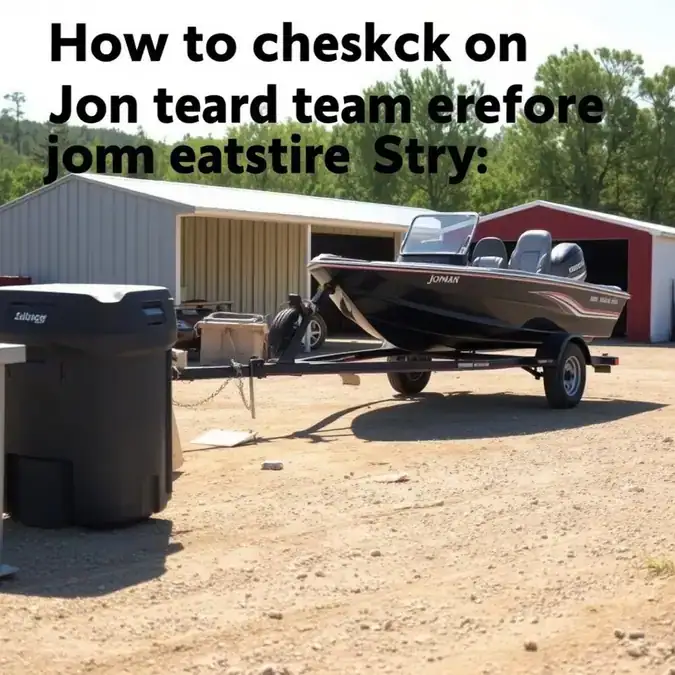
What to Check on Jon Boat Trailer Before Long Term Storage
I was struggling with my jon boat trailer sitting idle all winter — tires flat, bearings seized, lights corroded. Then I discovered a simple checklist that saved me thousands in repairs. After fifteen years hauling aluminum jon boats across the Midwest, I’ve learned the hard way what happens when you skip the prep work. This guide walks you through every critical check so your trailer’s ready to roll when spring hits.
- Inspect the frame first — cracks, rust, and bent members compromise everything else
- Tires need pressure relief — jack the trailer or rotate monthly to prevent flat spots
- Repack bearings annually — old grease holds moisture that destroys races
- Disconnect the battery — parasitic draw kills it in weeks, not months
- Coat exposed metal — fluid film or corrosion inhibitor beats bare steel every time
- Document everything — photos and notes make spring recommissioning painless
Why Proper Storage Prep Matters

Jon boat trailers sit low. They splash through launch ramps, bake in summer sun, and freeze in winter storage. That cycle eats metal faster than almost anything else you own. A buddy of mine skipped bearing service for two years — cost him a spindle, hub, and a tow bill when the wheel departed on I-70. Three hundred dollars in grease and seals would’ve prevented it.
The keyword here is prevention. What to check on jon boat trailer before long term storage isn’t a suggestion — it’s insurance. You’re protecting a $2,000 to $8,000 asset with maybe $50 in supplies and an afternoon of work. The math is stupid simple.
Most guys focus on the boat. They winterize the motor, stabilize fuel, pull the drain plug. The trailer? “It’s just metal.” Until it isn’t. Rust doesn’t sleep. UV doesn’t take weekends off. Mice don’t care about your fishing plans.
Frame and Structural Inspection

Walk the Length With a Flashlight
Start at the tongue. Look for cracks where the coupler welds to the frame. Stress fractures love that junction. Run your fingers along the welds — you’ll feel pinholes before you see them. If light passes through a weld, it’s failed.
Check the crossmembers. Jon boat trailers often use C-channel that traps water. Drill 3/16-inch weep holes at the lowest point of each section if they don’t exist. I drill mine every fall. Takes ten minutes, saves the frame.
Axle Alignment and Spring Mounts
Measure from the center of the coupler to each wheel center. Should match within 1/8 inch. More than that means a bent axle or shifted spring mount. Look at the U-bolts — are they tight? Are the spring eyes wallowed out? That’s a spring replacement waiting to happen.
Coupler and Safety Chains
Latch the coupler on a 2-inch ball. It should snap clean with no play. Wiggle it — any fore-aft movement means the latch mechanism is worn. Replace the coupler, not the ball. Chains need grade 43 minimum, hooks with latches, length so they don’t drag but cross under the tongue.
Tire and Wheel Maintenance

Pressure and Position
ST tires (Special Trailer) run higher pressure than passenger tires — usually 50-65 PSI. Check the sidewall. Inflate to max cold pressure before storage. Why? Because tires lose 1-2 PSI per month naturally. Starting at max gives you buffer.
Better yet: jack the trailer. Put it on stands. Tires off the ground don’t flat-spot. If you can’t jack it, move the trailer 12 inches every month. Rotate the contact patch. Flat spots on ST tires don’t always round out — the sidewalls are stiffer.
Sidewall Inspection
Look for weather checking — those fine spiderweb cracks. ST tires age out before they wear out. DOT date code on the sidewall: last four digits are week and year. “2319” means week 23 of 2019. Five years max on trailer tires, regardless of tread. Seven if you’re gambling.
Wheel Condition
Steel wheels rust from the inside out. Check the bead seat area. Run a wire brush over the mounting face. If you see pitting deeper than a credit card is thick, replace the wheel. Aluminum wheels check for corrosion around lug holes and valve stems.
Bearing and Hub Service

Why Annual Repack Isn’t Optional
Water gets past seals. It emulsifies grease into mayo. That mayo has zero lubricity. Bearings run dry, heat up, weld themselves to the race. Then the hub spins on the spindle. Game over.
Pull every hub. Clean with solvent. Inspect races for pitting, blueing, scoring. Roll each bearing between thumb and forefinger — feel for roughness. Any catch? Replace the set. Races and bearings come matched. Don’t mix brands.
Seal Replacement
Seals are $3 each. Don’t reuse them. Double-lip seals with spring retainers are worth the extra dollar. Tap them in square with a socket that matches the outer diameter. Crooked seal leaks in a week.
Grease Choice
Marine-grade lithium complex. NLGI #2. Blue or red, doesn’t matter — spec matters. Fill the bearing cavity full. Pack the hub cavity 1/3 full. Too much grease blows seals. Too little leaves air pockets that fill with water.
EZ Lube vs. Traditional
If you have EZ Lube axles (grease fittings on spindle ends), you still pull hubs annually. The fitting pushes new grease in but doesn’t purge old contaminated grease out. Use the fitting for mid-season top-offs only.
Brake System Check
Surge Brakes
Most jon boat trailers run surge actuators. Pull the breakaway pin — the lever should move freely and snap back. Check the master cylinder fluid. DOT 3 or 4, clear amber. Dark fluid means moisture. Flush it.
Bleed each wheel cylinder. Order: right rear, left rear, right front, left front (if tandem). Watch for air bubbles. Firm pedal at the actuator means you’re done.
Electric Brakes
Less common on jon trailers but worth checking. Test with a brake controller at 5 mph — should grab evenly. Check magnet wear through the inspection hole. Magnets wear uneven — replace in pairs per axle.
Brake Lines
Rubber hoses at each wheel flex. Cracks form at the crimp. Squeeze them — soft or mushy means internal delamination. Replace all four if one is bad. Steel lines rust at the clips. Run your fingers along — flaking scale means replace.
Lighting and Electrical
LED Upgrade
If you still have incandescent, upgrade. LEDs draw 1/10 the current, last 20x longer, and don’t care about vibration. Submersible kits are $40-60. Wire them once, forget them.
Connector and Wiring Harness
Unplug the 4-pin or 7-pin. Spray dielectric grease in both halves. Check pins for green corrosion — that’s copper oxide, high resistance. Clean with a pin file or replace the plug. $8 part.
Trace the harness. Look for chafed insulation where it passes over the tongue, through frame holes, at the license plate bracket. Tape or loom any bare spots. Mice love wiring insulation — wrap critical runs in conduit if rodents are an issue.
Breakaway Battery
Surge trailers with brakes need a breakaway battery. Test it — press the test button on the charger. Voltage should hold 12V+ under load. Replace every 3 years. Disconnect it for storage or put a maintainer on it.
Winch and Tongue Components
Winch Strap and Cable
Unspool the whole thing. Frayed strands? Replace. Strap with torn stitching? Replace. Cable with kinks? Replace. A $25 strap beats a boat sliding off at 60 mph.
Lube the winch gears with white lithium grease. Check the ratchet pawl — spring should snap it positive. Winch post bolts tight? They loosen from vibration.
Tongue Jack
Crank it full up and down. Smooth? Grease the gears. Side-to-side play? The pivot bolt or bushing is worn. Electric jack — test with a known-good battery. Clean the contacts.
Spare Tire Carrier
Spare mounted on the tongue? Check the bolt. They vibrate loose. Spare on the frame? Same deal. Spare tire itself — check pressure, date code, condition. Useless spare is dead weight.
Bunk and Roller Condition
Bunk Boards
Carpet holds water. Rot happens underneath. Peel back a corner — if the wood is soft, replace both bunks. Pressure-treated 2×6, marine carpet, stainless staples. Seal the wood ends with epoxy before carpeting.
Rollers
Spin each roller. Wobble? Bad bearing. Flat spot? Urethane cracked? Replace. Keel roller takes the most load — check it twice. Roller brackets bolt to the frame — those bolts shear. Grade 8 replacements.
Bunk Brackets
Adjustable brackets slide. Rust seizes them. Penetrating oil, work them free, grease the slots. Set bunks so the boat sits on the chines, not the keel. Chines carry load better.
Corrosion Protection
Fluid Film and Woolwax
Lanolin-based. Creeps into seams. Self-healing. Spray every cavity — frame tubes, bunk brackets, spring mounts, brake backing plates. Do it after washing, before storage. Reapply mid-winter if you can access it.
Electrical Connections
Dielectric grease on every plug, bulb socket, ground ring terminal. Grounds fail first. Clean the ground point to bare metal, star washer, dielectric, bolt tight.
Fasteners
Stainless bolts in aluminum frames gall. Use anti-seize. Steel bolts in steel — light oil on threads. Never dry-assemble anything that sees water.
Security and Theft Prevention
Coupler Lock
Good lock costs $40-80. Hammer-resistant, pick-resistant. Master Lock, Proven Industries, Blaylock. Cheap locks are theater.
Wheel Lock
Boot style or lug nut lock. Slows them down. Layer security — coupler lock plus wheel lock plus chain to immovable object.
GPS Tracker
Hidden magnetic mount. $150 unit, $10/month. Peace of mind. Police recover stolen trailers with trackers 80% of the time. Without? Maybe 10%.
Documentation and Records
Photo Everything
Phone camera. Shoot the frame, bearings, tires, brakes, lights, winch, bunks. Date-stamped. Spring you comes back and wonders “was that crack there before?” Photos answer.
Maintenance Log
Notebook in the glove box. Date, mileage, work done, parts numbers. Next owner loves it. You love it when you can’t remember if you repacked bearings last fall or the fall before.
Parts List
Bearing numbers (L44649/L44610 common), seal numbers, tire size, brake shoe size, light model numbers. Write them down. Auto parts store counter guy appreciates it.
Common Mistakes to Avoid
- Washing with a pressure washer — forces water past seals. Use a garden hose.
- Storing with the boat on — hull weight on bunks for months creates hard spots. Block the frame, take the boat off.
- Ignoring the spare — flat spare when you need it is worse than no spare.
- Using chassis grease — not waterproof. Marine grease only.
- Forgetting the breakaway cable — required by law in most states. Test it.
- Parking on grass/dirt — moisture wicks up. Concrete, gravel, or blocks.
- Covering with a tarp that touches tires — traps moisture, accelerates dry rot. Tent the cover.
Seasonal Timeline
| Timing | Task |
|---|---|
| 2 weeks before storage | Full wash, inspect, order parts |
| 1 week before | Repack bearings, service brakes |
| Storage day | Jack up, pressure tires, disconnect battery, apply corrosion inhibitor, lock up, photograph |
| Monthly | Check tire pressure, rotate if on ground, verify locks, check for rodent signs |
| 2 weeks before launch | Lower from stands, test lights, test brakes, check winch, verify registration |
Tools and Supplies Needed
- Floor jack (2-ton minimum) and jack stands (4)
- Lug wrench or impact with 13/16, 3/4, 7/8 sockets
- Bearing packer tool ($15) or palm method
- Marine grease (14 oz tub)
- Seal puller or large screwdriver
- Seal driver (socket matching seal OD)
- Brake bleed kit or clear tubing + bottle
- DOT 3/4 brake fluid (fresh bottle)
- Dielectric grease (small tube)
- Fluid Film or Woolwax (2 cans)
- Wire brush, shop rags, nitrile gloves
- Torque wrench (lug nuts: 90-100 ft-lb typical)
- Multimeter for electrical checks
- Coupler lock, wheel lock, chain
Quick Comparison Table
| Feature | Basic Prep | Thorough Prep | Pro Level |
|---|---|---|---|
| Time Investment | 2 hours | 4-6 hours | Full day |
| Cost | $30-50 | $80-150 | $200-400 |
| Bearing Service | Grease fitting only | Full repack + seals | Repack + races + bearings |
| Tires | Air up | Air up + jack stands | Jack stands + tire covers + nitrogen |
| Corrosion | Spray visible parts | Full frame cavity spray | Cavity spray + undercoating |
| Security | Coupler lock | Coupler + wheel lock | Coupler + wheel + GPS + chain |
| Documentation | Mental note | Photos + parts list | Photos + log + video walkaround |
| Best For | Heated garage, <3 months | Outdoor, 3-6 months | Outdoor, 6+ months, high theft area |
FAQs
How often should I repack jon boat trailer bearings?
Annually. Every 12 months or 12,000 miles, whichever comes first. Saltwater use — every 6 months.
Can I leave my jon boat on the trailer during winter storage?
Better not. Hull weight on bunks creates hard spots. Block the trailer frame, store the boat separately on saw horses or blocks.
What tire pressure for storage?
Max cold pressure on the sidewall. Usually 50-65 PSI for ST tires. Check monthly.
Do I need to service surge brakes every year?
Yes. Fluid absorbs water. Flush and bleed annually. Wheel cylinders leak eventually — catch it in the garage, not the ramp.
What’s the best corrosion spray for trailer frames?
Fluid Film or Woolwax. Lanolin-based, creeps, self-heals, non-drying. Cheap hardware store sprays wash off in two rains.
How do I keep mice out of my trailer wiring?
Conduit on critical runs, peppermint oil cotton balls in frame tubes (replace monthly), no food sources nearby, trap line around the trailer.
Should I cover my trailer tires?
Yes. UV kills sidewalls. Tire covers are $20 for a set. Or plywood leaned against them. Just don’t let the cover trap moisture against the tire.
What grease for trailer bearings?
Marine-grade lithium complex NLGI #2. Blue or red. Not chassis grease, not wheel bearing grease without marine rating.
How tight should lug nuts be?
Torque to spec — typically 90-100 ft-lb for 1/2-inch studs. Check after 50 miles, then annually.
Do I need a breakaway battery for a jon boat trailer?
If your trailer has brakes and GVWR over 3,000 lbs, yes — federal law. Most jon trailers with brakes need one. Test it.
Conclusion
What to check on jon boat trailer before long term storage boils down to one thing: water is the enemy. Every step above — bearing repack, brake flush, corrosion spray, tire relief, electrical grease — fights water in some form. You’re not maintaining a trailer. You’re managing moisture.
I’ve seen guys skip this for years and get lucky. I’ve seen guys skip it once and lose a wheel on the interstate. The difference isn’t luck — it’s the checklist. Print this. Laminate it. Keep it in your shop. Next fall, you’ll thank the version of you that took the afternoon to do it right.
Your jon boat waits for spring. Make sure the thing carrying it does too.