
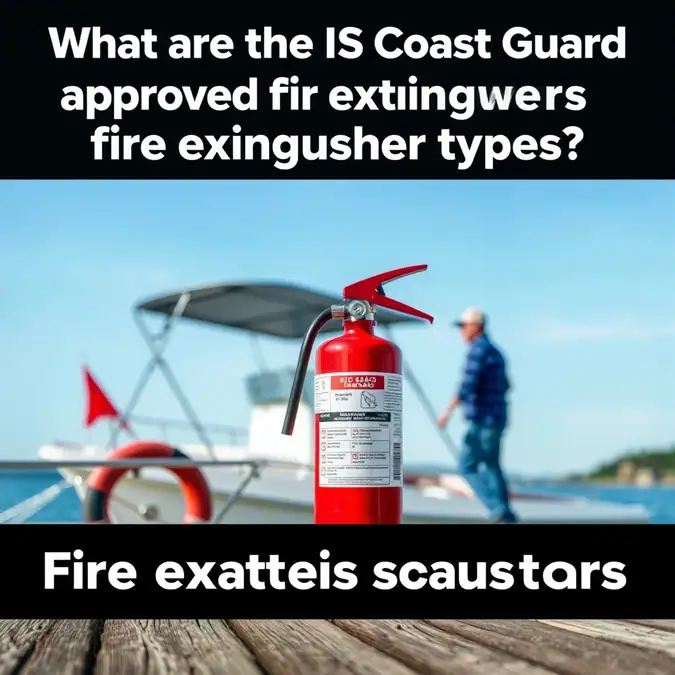
What Are Coast Guard Approved Fire Extinguisher Types for Boats

Imagine you are out on the lake and a small fire starts near the engine. Do you have the right tool to stop it fast? This guide shows exactly what fire extinguisher types the US Coast Guard approves for boats. You will learn how to pick the right size, where to mount it, and how to keep it ready. Knowing this can keep you, your crew, and your boat safe on every trip.
What are the US Coast Guard approved fire extinguisher types for boats?
The US Coast Guard approves fire extinguishers that meet UL standards. They must be marked with a marine label. The main types are Class B and Class C. Some boats also need Class D for metal fires. Each type fights a different kind of fire. You will see the label “Marine Type B:C” on many units. This means it works on fuel and electrical fires. Always check the label before you buy.
Class B extinguishers stop fires from gasoline, oil, and grease. Class C extinguishers stop fires from live electrical equipment. Class D extinguishers stop fires from burning metals like magnesium. Most recreational boats need only B and C types. Larger vessels with special equipment may need D. The label will tell you the exact class.
The USCG also requires a minimum size based on boat length. Boats under 26 feet need at least one B‑I extinguisher. Boats 26 to 40 feet need at least one B‑II or two B‑I. Boats over 40 feet need more. The size is shown by a number and letter like B‑I or B‑II. The higher the number, the more agent it holds.
Look for the USCG approval number on the label. It starts with “162.028” or similar. This number shows it passed Coast Guard tests. Never trust a unit without this number. It could fail when you need it most.
Some extinguishers are disposable. Others are rechargeable. Disposable units are cheaper but must be replaced after use. Rechargeable units can be refilled by a certified shop. Both types can be USCG approved if they meet the standards.
In short, the approved types are B, C, and sometimes D. They must have the marine label and the USCG number. Choose the size that matches your boat length. Keep it easy to reach and in good condition.
Remember, the label is your best guide. If you see “Marine” and the USCG number, you are good to go. If you are unsure, ask a marine shop for help. They can show you the right unit for your boat.
Having the right extinguisher is not just about rules. It is about peace of mind on the water. A small fire can grow fast. The right tool can stop it before it hurts anyone or damages your boat.
Now that you know the approved types, let’s look at how to pick the right size for your boat.
Next, we will discuss size selection in simple steps.
How do I choose the right size fire extinguisher for my boat?
Size matters because a too‑small unit may not put out the fire. A too‑large unit can be heavy and hard to mount. The USCG gives size rules based on boat length. Follow these steps to pick the right size.
First, measure your boat from the tip of the bow to the stern. Do this in feet. Write the number down. This length drives the size rule.
If your boat is less than 26 feet, you need at least one B‑I extinguisher. B‑I holds about 2.5 pounds of dry chemical. This is enough for small fuel or electrical fires.
If your boat is between 26 and 40 feet, you need either one B‑II or two B‑I units. B‑II holds about 5 pounds of agent. Two B‑I give you the same total but split into two spots.
If your boat is over 40 feet, the USCG asks for more. You may need one B‑II plus one B‑I, or three B‑I. Check the latest USCG boating safety guide for exact numbers.
Always round up if you are between sizes. It is better to have a little extra agent than to be short.
Consider where you will mount the unit. A heavy B‑II may need a strong bracket. Two lighter B‑I units may fit in tighter spots.
Think about the type of boating you do. If you carry a lot of fuel, lean toward a larger size. If you mostly fish in a small skiff, a B‑I may be enough.
Check the label for the size code. It will look like “B‑I” or “B‑II”. Make sure it matches the rule for your boat length.
Finally, ask a marine store to confirm your choice. They can show you the weight and size of each unit. Pick the one you can lift and reach easily.
Choosing the right size keeps you safe and follows the law. Now let’s see what the different classes actually fight.
What is the difference between Type B, C, and D extinguishers for marine use?
Each letter stands for a class of fire. Knowing the class helps you pick the right tool.
Class B fights flammable liquids. This includes gasoline, diesel, oil, and grease. On a boat, fuel leaks or spills can create a B‑type fire. The extinguisher coats the fuel and stops the reaction.
Class C fights live electrical fires. This includes wiring, batteries, motors, and panels. If a wire shorts and sparks, a C‑type extinguisher will stop it without conducting electricity.
Class D fights fires from burning metals. Examples are magnesium, titanium, and sodium. These are rare on most pleasure boats but can appear in workshops or with special gear.
Most marine extinguishers combine B and C. You will see a label like “B:C”. This means it works on both fuel and electrical fires. It is the most common choice for recreational boats.
If you see only a “B” label, it will not work on electrical fires. Use it only in the engine room or fuel area where electricity is not live.
If you see only a “C” label, it will not work on fuel fires. Use it near batteries or electrical panels.
Class D extinguishers are usually a special powder. They are not mixed with B or C. You will need a separate unit if your boat has metal‑working equipment.
To choose, look at where fires are most likely. Fuel areas need B. Electrical areas need C. If you have both, get a B:C unit.
Always read the label before you buy. The label tells you exactly what fires it can stop.
Understanding the classes helps you stay prepared. Next, we will look at how often you should check your extinguisher.
How often should I inspect and service my boat fire extinguisher?
Regular checks keep the extinguisher ready when you need it. A simple monthly look can catch problems early.
First, check the pressure gauge. The needle should be in the green zone. If it is in the red, the unit may be under‑ or over‑charged.
Second, look at the nozzle and hose. Make sure they are not cracked, blocked, or dirty. A clear path lets the agent flow out fast.
Third, examine the pin and tamper seal. The pin should be in place and the seal unbroken. If the seal is missing, someone may have used the unit.
Fourth, lift the extinguisher. Feel for any weight change. A big loss of weight could mean a leak.
Fifth, look at the label. Make sure the USCG number and marine mark are still clear.
Do this check every month, or before each long trip. Write the date on a tag attached to the unit.
Besides the monthly look, you need a professional service once a year. A certified shop will weigh the unit, test the pressure, and refill if needed.
If you use the extinguisher, even a little, you must service it right after. Do not wait for the yearly check.
Keep a record of each service. This helps you stay on schedule and shows proof if asked by authorities.
If the unit fails any check, replace it or have it repaired. Never trust a damaged extinguisher.
Simple monthly checks take only a few minutes. They can save your boat and your life.
Now let’s talk about where to put the extinguisher on your boat.
Where should I mount fire extinguishers on my boat?
Placement is key for fast access. You want to reach the unit in seconds, not minutes.
First, mount it where you can see it. A visible spot reminds everyone it is there.
Second, keep it near the exit. If you need to leave the boat fast, you can grab it on the way out.
Third, avoid places that get very hot or wet. Heat can raise pressure. Water can rust the cylinder.
Fourth, use a strong bracket that holds the weight. Check the bracket bolts often.
For boats under 26 feet, one common spot is near the helm or cockpit. This puts it close to the driver.
For boats 26 to 40 feet, consider two spots: one near the helm and one near the galley or engine room.
For boats over 40 feet, spread units throughout. Put one near each major area: helm, galley, engine room, and sleeping quarters.
Always mount the unit upright. The label should face out so you can read it quickly.
Make sure the mounting surface is solid. Do not attach to thin plastic or foam.
If you store the unit in a locker, keep the locker unlocked and easy to open. A lock can waste precious seconds.
Check the mount after rough weather. Vibration can loosen bolts.
Finally, tell your crew where each extinguisher is. Run a quick drill so everyone knows the grab‑and‑go spot.
Good placement saves time. Next, we will answer whether a regular home extinguisher works on a boat.
Can I use a regular household fire extinguisher on my boat?
Many homes have a dry‑chemical extinguisher for kitchen fires. It might look similar to a marine unit. But there are important differences.
First, household units often lack the USCG marine label. Without that label, they do not meet Coast Guard rules.
Second, the agent inside may be the same, but the cylinder may not be built for salt‑air exposure. Salt can corrode a non‑marine cylinder faster.
Third, the mounting bracket on a home unit may not be strong enough for boat vibration.
If you have a home extinguisher that is labeled “B:C” and has a USCG number, you can use it. Check the label carefully.
Most home extinguishers sold in stores are not tested for marine use. They may fail during a real boat fire.
Using a non‑approved unit can also lead to a fine if you are stopped by the Coast Guard.
For safety and legal compliance, buy a unit made for boats. Marine extinguishers are built to resist corrosion and vibration.
They also come with the right size brackets for boat mounting.