
Anchor Types for Small Boats
Looking for practical ways to improve Anchor Types for Small Boats? This guide breaks the work into clear sections—what to publish, how to structure it, and which supporting tactics actually move results.
You do not need every tactic on day one. Start with the fundamentals, ship consistently, then layer on distribution and measurement. The sections below are ordered so you can skim the Contents list and jump to what you need.
Contents
- Why Anchor Choice Matters for Small Boats
- The Three Main Anchor Categories Used on Small Boats
- Other Anchor Designs You Will See
- Matching Anchor Type to Seabed Conditions
- Sizing an Anchor for a Small Boat
- How to Deploy an Anchor Correctly
- Tips for Better Holding in Tricky Conditions
- Common Mistakes to Avoid
- Anchoring Etiquette in Crowded Anchorages
- Maintaining Your Anchor System
- Frequently Asked Questions
- Next Steps for Choosing Your Anchor
- Anchor Types for Small Boats: recap
Why Anchor Choice Matters for Small Boats
Small boats face different anchoring challenges than large cruising yachts. They have lighter displacement, less chain weight, smaller anchor lockers, and limited crew to help with deployment. The seabed in lakes, rivers, and nearshore coastal waters often shifts between mud, sand, weed, shell, and rock. Wind shifts and current changes can swing a light boat quickly, and a dragging anchor in crowded anchorage can cause serious damage.
For these reasons, small boat anchoring focuses on three things: holding power relative to weight, quick setting in variable bottom conditions, and easy stowage. The best anchor for your boat is the one that matches your typical conditions and is properly sized and rigged.
The Three Main Anchor Categories Used on Small Boats
Most anchor designs fall into three broad categories based on how they dig into the seabed.
Fluke-Style Anchors
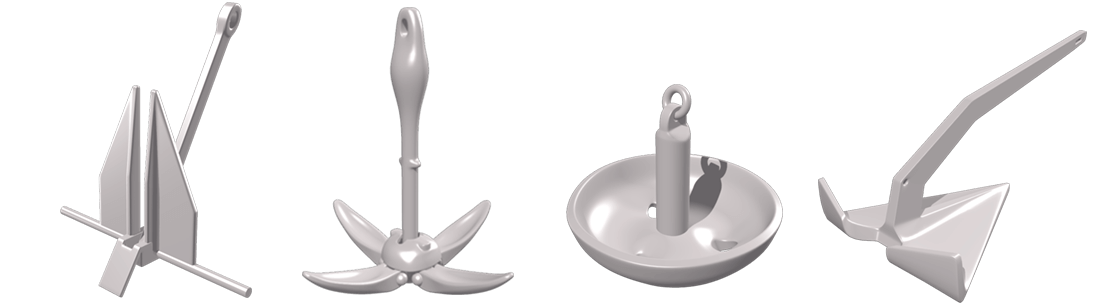
Fluke anchors, also called lightweight or flat anchors, have two broad triangular blades attached to a central shank. They rely on the flukes digging deep into soft bottom to hold. The classic example is the Danforth, which has long, flat flukes and a short shank. Fluke anchors are popular on small boats because they are light, fold flat for stowage, and hold very well in soft mud and sand once set. They perform less reliably in weed, hard sand, or rocky bottoms where the flukes cannot bury.
Plow-Style Anchors
Plow anchors have a single curved blade that pivots on a shank, similar to a farm plow. The most familiar design is the CQR (secure). Plows are self-setting in many conditions and reset themselves when the boat swings, which is helpful when wind or tide changes direction. They hold well in mixed bottoms including mud, sand, and clay. The trade-off is weight: plows are heavier than flukes of comparable holding power, which can be a problem on very small boats.
Claw and Spade-Style Anchors
Claw anchors (such as the Bruce design) have a wide, three-pronged head that grabs onto uneven bottom. They are known for setting quickly in rocky, weedy, or coral-strewn seabeds. Spade and ROCNA-type anchors combine a concave blade with a roll bar to ensure the fluke tips downward as soon as they touch bottom. Both designs hold well across a wide range of conditions but are heavier and bulkier than flukes.
Other Anchor Designs You Will See
Beyond the three main categories, a few specialty designs appear on small boats.
Grapnel Anchors
Grapnels have four or more folding tines arranged like a hook. They are inexpensive, compact, and good for rocky bottoms, wreck exploration, or temporary holding in a dinghy. They do not hold well in soft mud or sand because the tines do not bury deeply.
Mushroom Anchors
Mushroom anchors look like an upside-down mushroom and are used for permanent mooring of small craft rather than temporary anchoring. They work by suction in soft mud and are not suited to rocky or shifting bottoms.
Slide-Box or Folding Anchors
Slide-box designs fold flat into a low-profile box, which is handy for small tenders, kayaks, and inflatables with no anchor locker. They sacrifice some holding power for compact storage.
Matching Anchor Type to Seabed Conditions
The seabed in your favorite anchorage should drive your anchor choice more than brand loyalty. The table below summarizes how each anchor type performs on common bottoms. Holding ratings are general guidance; real performance depends on anchor weight, rode length, and seabed firmness.
| Anchor Type | Sand | Mud | Weed | Rock/Coral | Stowage |
|---|---|---|---|---|---|
| Danforth (fluke) | Excellent | Excellent | Fair | Poor | Compact, folds flat |
| CQR (plow) | Good | Good | Fair | Fair | Bulky, shank long |
| Bruce (claw) | Good | Good | Good | Good | Medium bulk |
| Spade/ROCNA-type | Excellent | Excellent | Good | Good | Medium-heavy |
| Grapnel | Poor | Poor | Fair | Good | Very compact |
| Mushroom | Fair | Excellent | Poor | Poor | Heavy, fixed mooring |
If you anchor mostly in sandy lakes or soft coastal mud, a fluke-style Danforth offers the best holding per pound and packs away small. If your cruising grounds include rocky inlets, kelp beds, or mixed bottom, a spade/ROCNA-type or Bruce claw anchor gives more consistent setting and resetting.
Sizing an Anchor for a Small Boat
Manufacturer sizing charts are a good starting point, but the general rule for recreational small boats is that anchor weight should be roughly 1 pound per foot of boat length for boats up to about 20 feet, and slightly heavier for boats in the 20 to 30 foot range. A 16-foot dayboat, for example, typically carries at least a 6 to 10 pound fluke or 9 to 15 pound plow. A 30-foot boat generally needs a 15 to 25 pound anchor depending on wind exposure.
Rode length matters as much as anchor weight. A common safe scope is 5 to 7 feet of rode for every foot of water depth in calm conditions, and 7 to 10 feet in heavy weather. Most small boats use a combination of chain and line: a short length of chain (called the leader or rider chain) at the anchor end, with the rest nylon line. The chain improves the angle at which the anchor pulls, helps the flukes dig, and resists chafe on rocky bottom.
How to Deploy an Anchor Correctly
Even the best anchor drags when deployed badly. A predictable routine reduces the chance of a problem.
- Choose a sheltered spot with enough swinging room for other boats and a seabed that matches your anchor type.
- Check depth and tide. Estimate depth at high tide and multiply by your planned scope to know how much rode you need to let out.
- Approach slowly with the bow into the wind or current. Stop the boat when you reach the spot where you want the bow to lie once anchored.
- Lower the anchor rather than throwing it. Let it settle to the bottom to avoid tangling the rode.
- Pay out rode as the boat drifts back, keeping slight tension so the anchor digs in.
- Take up tension gently by reversing briefly or letting the wind take the boat back to the anchor. You should feel the boat catch and the rode go taut.
- Verify the set by sighting a landmark on shore at the bow and checking after a few minutes that the boat is not drifting.
Many skippers find it helpful to set an anchor alarm on a chart plotter or phone app. A circle of, say, 30 to 60 feet around the anchor position will alert you if the boat moves outside that range, which often means the anchor is dragging.
Tips for Better Holding in Tricky Conditions
- Use more scope, not more power. When wind picks up, let out additional rode before adding a second anchor. A longer scope improves holding more than a heavier pull.
- Anchor into the wind or current first. This keeps the boat under control during deployment and lets the anchor set with maximum load in the right direction.
- Set the anchor hard. After the boat is settled, reverse at idle speed against the rode for a few seconds to confirm it has dug in.
- Add a kellet or sentinel weight partway down the rode to reduce catenary and shock load in choppy water.
- Carry a backup. A small second anchor on a separate rode is invaluable if the primary drags overnight or conditions shift.
- Match the bottom. In thick weed, look for a clear patch. In rocky areas, choose a sandy pocket between rocks. The best holding is where the flukes can reach clean bottom.
Common Mistakes to Avoid
- Using rope-only rode with no chain. Without a short chain leader, the rode lifts off the bottom near the anchor and can pull the flukes out of the seabed.
- Too little scope. Short rode puts nearly vertical pull on the anchor, which extracts flukes quickly under load.
- Underweight anchors. A tiny anchor that “should be enough” often drags the first time a gust hits.
- Setting in the wrong bottom. A fluke anchor in thick kelp or a grapnel in soft mud will not hold regardless of size.
- Skipping the verification step. Many anchoring mishaps start with an anchor that never properly set. Always check for a firm hold before walking away from the helm.
- Forgetting chafe protection. Nylon line rubbing on a rough bow roller or chock can part in minutes. Use chafe gear where the rode contacts the boat.
Anchoring Etiquette in Crowded Anchorages
Good etiquette keeps everyone safe. Always allow room for your boat to swing in a full circle as wind or tide reverses, and avoid dropping inside another boat’s swing radius. Do not anchor close to channels, mooring buoys, or marked navigation features. When other boats arrive after you, signal them if they appear to be anchoring too close so you can agree on swing room. If you leave before others, raise your anchor quietly and motor past without disturbing swinging boats.
A small boat should also display an anchor ball during daylight if the local rules require it, and use the proper light at night. Quiet behavior, organized deck work, and predictable movements all reduce risk in a crowded bay.
Maintaining Your Anchor System
Anchors and rodes last a long time with simple care. After each trip, rinse the anchor with fresh water to remove salt and grit. Inspect the shackle pin, swivels, and fluke hinges for corrosion or bending. Check chain links for wear and replace any section where links are stretched or thinned. Nylon line should be inspected for cuts, glazing, or stiffness and replaced every few years depending on use. Store the anchor so it cannot shift in the locker and damage other gear.
Frequently Asked Questions
What are the different types of boat anchors?
The main anchor designs are fluke (such as Danforth), plow (such as CQR), claw (such as Bruce), spade-type with roll bar (such as ROCNA), grapnel, and mushroom. Each design is suited to particular seabeds and boat sizes.
What are the three main types of anchors?
The three main categories are fluke anchors that dig with broad blades, plow anchors that cut in with a single curved blade, and claw or spade anchors that grip with a heavy concave head. Most recreational small boat anchors fall into one of these groups.
What size anchor do I need for a 30 foot boat?
A 30 foot boat typically needs a 15 to 25 pound anchor depending on wind exposure, plus at least 200 feet of rode with a short chain leader. Boats in rough or deep-water anchorages should size up and carry a heavier anchor or a backup.
How do I determine what type of anchor to use?
Start with the seabed you anchor in most often. Soft mud and sand favor a fluke anchor. Mixed and rocky bottoms favor a claw or spade design. Then check your storage space and total displacement so the anchor is heavy enough to hold without overloading the boat.
Do tiny anchors actually work?
Very small anchors can hold a light dinghy or kayak in calm conditions on soft bottom, but they will not hold any boat in wind or current. They are useful as backups or for temporary stops, never as the primary anchor for an unattended boat.
How much chain do I need on a small boat?
Most small boats run well with 6 to 15 feet of chain between the anchor and the nylon rode. The chain improves the pull angle, helps the anchor set, and protects the line from chafe. In very rocky areas, a longer chain leader is helpful.
Can I use the same anchor in fresh and salt water?
Yes, the same anchor works in both, but rinse it after salt water use to prevent corrosion. Galvanized or stainless anchors hold up best to repeated salt exposure.
Should I carry two anchors?
Carrying a second, smaller anchor is a smart idea. It serves as a backup if the primary drags and is useful for setting a Bahamian mooring, holding the bow while you set the main anchor, or anchoring stern-to in a tight spot.
Next Steps for Choosing Your Anchor
To choose the right anchor for your boat, start by listing the bottoms you actually anchor in, the typical wind and weather you see, and the storage space you have for the anchor and rode. Use the sizing guidance above to pick a minimum weight, then match the design to your most common bottom. Build a rode with a proper chain leader, learn to set and verify the anchor every time, and carry a small backup. With a well-matched anchor system and a consistent routine, your boat will hold securely in almost any small boat anchorage you choose.
Anchor Types for Small Boats: recap
Treat Anchor Types for Small Boats as a system: useful content, solid on-page structure, distribution, and a short measurement loop. Ship one improvement at a time, then expand.
- Why Anchor Choice Matters for Small Boats: apply the subsections above in order of impact for your situation.
- The Three Main Anchor Categories Used on Small Boats: apply the subsections above in order of impact for your situation.
- Other Anchor Designs You Will See: apply the subsections above in order of impact for your situation.
- Matching Anchor Type to Seabed Conditions: apply the subsections above in order of impact for your situation.
- Sizing an Anchor for a Small Boat: apply the subsections above in order of impact for your situation.
- How to Deploy an Anchor Correctly: apply the subsections above in order of impact for your situation.
Bookmark this page and revisit the Contents list whenever you need a specific tactic—consistency beats one-off bursts of effort.
1 thought on “Anchor types for small boats”