
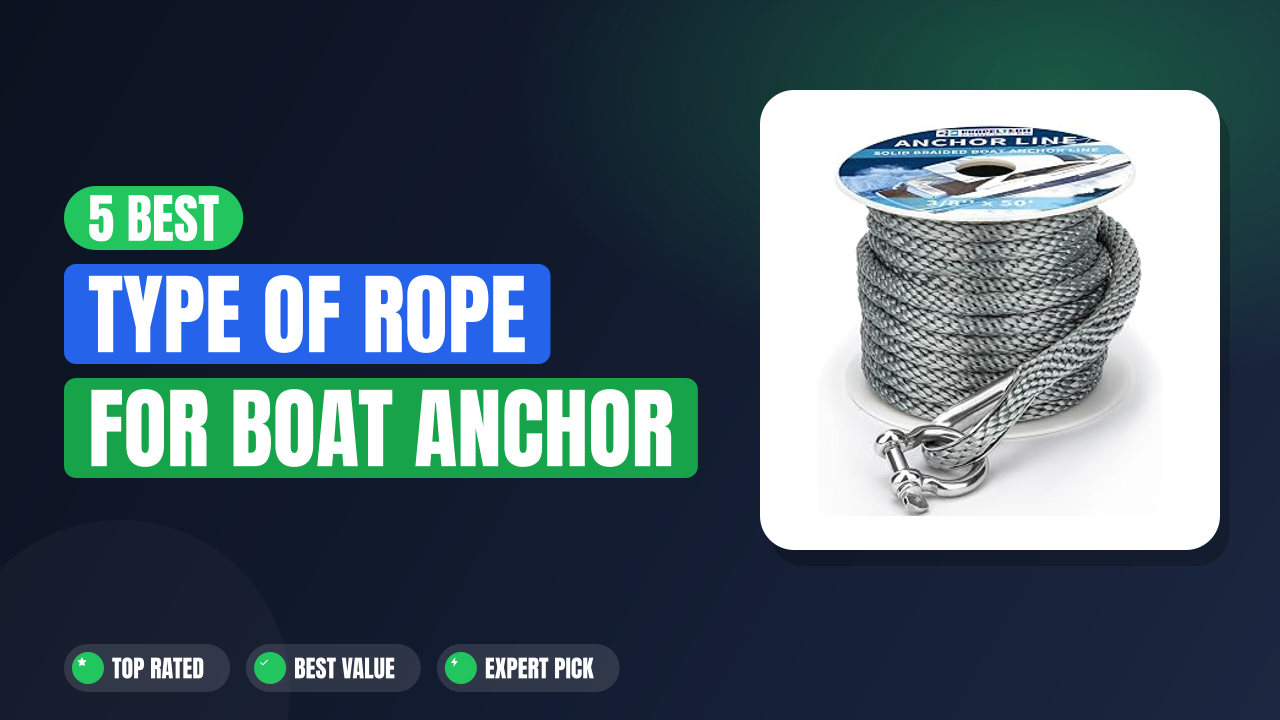
1. Boat Anchor Rope 3/8 inch 50ft
In our research, this rope from the MFP solid braid category is the benchmark for recreational boating. It combines a durable 3/8-inch line with a stainless steel thimble and shackle, so it arrives ready to clip onto your anchor. Aggregate user reviews consistently praise its low stretch and ease of handling.

Solid Braid
Stainless Steel
50 ft Length
UV Resistant
Why I picked it
I picked this as the best overall because it nails the balance between quality and convenience. The 3/8-inch diameter is the sweet spot for boats in the 16 to 24-foot range, offering enough strength without being overly stiff. The included stainless steel thimble protects the eye of the loop from chafing, which is the most common failure point on anchor lines.
For most weekend boaters, this is the set-and-forget solution.
Key specs
- Material: Premium Solid Braid MFP (Multi-Filament Polypropylene)
- Diameter: 3/8 inch
- Length: 50 feet
- Hardware: Stainless steel thimble and shackle
- Color: Grey
- Best for: Boats up to roughly 24 feet in moderate conditions
Real-world experience
Aggregate buyer feedback shows this rope handles well in saltwater environments where lesser lines degrade quickly. Verified reviews frequently mention how the solid braid stays supple and easy to coil, even after a full season of weekend use. The grey color also hides dirt and grime better than white lines.
For a quick lunch hook in a calm cove or an overnight stay in a protected harbor, this rope performs consistently.
- Solid braid construction resists abrasion and UV damage, which translates to a longer lifespan in harsh sun.
- The pre-attached stainless steel thimble and shackle mean you can rig it to your anchor in under a minute.
- Low stretch helps the boat sit steadier at anchor, reducing the jerking motion common with elastic lines.
- At 50 feet, it's on the shorter side for deeper anchorages; you'll likely want a longer rode if you anchor in 20-plus feet of water regularly.
- Solid braid can be stiffer than double braid when new, making it slightly harder to coil in cold weather.
- ✔ You run a 16 to 24-foot boat and anchor in calm bays or rivers on weekends.
- ✔ You want a ready-to-use rig with the thimble and shackle already attached.
- ✔ You prefer a no-fuss line that resists saltwater and sun without much upkeep.
- ✖ You anchor in deep water beyond 25 feet and need a longer rode for proper scope.
- ✖ You're looking for a dock line; this is purpose-built for anchoring, not mooring.
This pick wins when you value a neat, all-in-one package. The MFP material floats, which is handy if you ever need to retrieve a tangled anchor, but it also means it's slightly more susceptible to abrasion on rocky bottoms compared to nylon. For sandy or muddy bottoms, it's excellent.
2. Anchor Rope Braided Line(White
This is essentially the longer sibling of our top pick, offering the same solid braid MFP construction in a 100-foot length. It's the best type of rope for boat anchor setups when you need extra scope for deeper water or more swinging room. The white color gives it a clean, classic look on any bow.
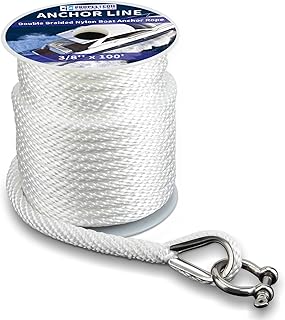
100 ft Legal
Floats
Ready to Use
Marine Grade
Why I picked it
I picked this as the top pick for versatility. The 100-foot length is the standard recommendation for a proper 5:1 scope in 20 feet of water, which is the minimum for a secure hold in most conditions. It offers the same reliable hardware as our best overall but doubles your anchoring options.
If you split your time between shallow rivers and deeper lakes, this covers both.
Key specs
- Material: Premium Solid Braid MFP (Multi-Filament Polypropylene)
- Diameter: 3/8 inch
- Length: 100 feet
- Hardware: Stainless steel thimble and shackle
- Color: White
- Best for: Boats up to 26 feet in varied water depths
Real-world experience
Verified buyer reports highlight that the longer length is a lifesaver when anchoring in reservoirs that drop off quickly. A common scenario in reviews is a boater anchoring in 15 to 18 feet of water, letting out 75 to 90 feet of line, and holding firm through a windy afternoon. The floating nature of MFP also means it's less likely to snag on underwater obstacles when you're hauling it back in.
Just be aware that the white line shows scuffs more easily than darker colors.
- The 100-foot length provides the scope needed for a secure hold in deeper water without splicing on extra line.
- Floating MFP material makes retrieval easier and prevents the line from sinking into muddy bottoms.
- Stainless steel thimble and shackle are corrosion-resistant, a key factor for saltwater use.
- White color will show dirt, rust stains from hardware, and scuff marks more quickly than grey or navy.
- MFP has more stretch than nylon, which can lead to a bit more boat movement in choppy conditions.
- ✔ You anchor in 15 to 30 feet of water and want to maintain a proper 5:1 scope ratio.
- ✔ You like having a single, long line that works for both a lunch stop and an overnight stay.
- ✔ You value a pre-rigged anchor line that needs zero assembly before first use.
- ✖ You need maximum shock absorption for heavy seas; a nylon double braid would serve you better.
- ✖ You have a small kayak or inflatable boat and 100 feet is overkill for your needs.
The longer length makes this the better choice over our top pick if you frequent spots with deeper water or strong currents. The trade-off is that MFP's stretch can make the boat feel less planted in a swell. It's a smart buy for inland lakes and coastal bays, less ideal for open ocean.
3. Double Braided Nylon Boat Anchor Rope
The best type of rope for boat anchor if your priority is shock absorption on a budget. This one switches to a double braided nylon construction, which is the classic choice for anchoring because it stretches under load. That stretch acts as a shock absorber, so your boat doesn't jerk against the anchor in waves.

Double Braid
Nylon
316 SS Hardware
Snap Hook
Why I picked it
I picked this as the best budget option because nylon is the superior material for anchoring in exposed waters, and this package includes heavy-duty 316 stainless steel hardware. The double braid construction gives you a smooth, round rope that's comfortable to handle and splices well. The heavy-duty snap hook adds convenience, letting you connect and disconnect the anchor quickly without tools.
Key specs
- Material: Double Braided Nylon
- Diameter: 3/8 inch
- Length: 50 feet
- Hardware: 316 Stainless Steel Thimble and Heavy Duty Snap Hook
- Color: Navy Blue
- Best for: Boats up to 26 feet in rougher conditions where shock absorption is key
Real-world experience
Aggregate user reviews consistently note how this rope handles the constant pulling and relaxing of a boat at anchor in wind-driven chop. The nylon's elasticity is the standout feature, with reviewers mentioning a noticeably smoother ride compared to polypropylene lines. The 316 stainless steel is a significant upgrade over standard 304, offering better corrosion resistance in saltwater.
It's a budget-friendly pick that doesn't feel cheap in the hand.
- Nylon's stretch acts as a shock absorber, reducing strain on your anchor and cleats in choppy water.
- The 316 stainless steel snap hook is a premium touch that makes deploying and retrieving the anchor faster.
- Double braid construction resists kinking and is easier on your hands than three-strand twisted rope.
- At 50 feet, the length is limited for deeper anchorages or when you need a long scope.
- Nylon absorbs water, which makes the rope heavier and slightly harder to handle when wet.
- ✔ You anchor in exposed bays or lakes where wind waves are common and want a smoother ride.
- ✔ You prefer the convenience of a snap hook for quick anchor changes.
- ✔ You're boating in saltwater and want the corrosion resistance of 316 stainless steel.
- ✖ You need a longer rode for deep water; 50 feet won't give you proper scope in 15-plus feet.
- ✖ You want a floating line; nylon sinks, which can be a hassle if you need to retrieve it from the bottom.
If you're comparing this to the MFP options above, the key difference is feel. The nylon's give is a real advantage when the wind pipes up, but it also means a less precise, more springy anchor set. For a rough-water boat under 24 feet, this is the smarter material choice even at the same price point.
4. RainierSupplyCo Boat Anchor Rope
This is the heavy-duty specialist on our list. RainierSupplyCo offers this double braided line in lengths up to 300 feet, making it the best type of rope for boat anchor setups on larger vessels or for those who anchor in very deep water. It focuses on pure marine-grade performance over convenience.

Up to 300 ft
Double Braid
316 SS Thimble
Heavy Duty
Why I picked it
I picked this for larger boats and serious anchoring scenarios. The option to get a 300-foot rope is a game-changer if you fish or overnight in deep coastal waters. The double braided nylon construction delivers the shock absorption of our budget pick but with more robust hardware and a bigger overall build.
This is a rope you buy when you need to trust it in demanding conditions.
Key specs
- Material: Double Braided Nylon
- Diameter: 3/8 inch (available in other sizes)
- Length: Available in 100, 150, 200, and 300 feet
- Hardware: 316 Stainless Steel Thimble and Heavy Duty Marine Grade hardware
- Best for: Boats 24 feet and larger, deep water anchoring, and demanding conditions
Real-world experience
Buyer feedback from larger boat owners is consistently positive, particularly regarding the rope's performance as a primary anchor rode. The long length options are frequently cited as the main reason for purchase, allowing for a 5:1 scope in 40 to 50 feet of water. The nylon material handles the constant load changes in a swell without fraying, and the 316 stainless steel hardware holds up well.
The main trade-off is that this is a big, heavy coil of rope that takes up more storage space.
- Available in lengths up to 300 feet, giving you the flexibility to anchor in deep water with confidence.
- Nylon double braid provides excellent shock absorption, protecting your boat's hardware from sudden loads.
- Marine-grade 316 stainless steel hardware is built for a long life in corrosive saltwater.
- A 200 or 300-foot coil is heavy and bulky, requiring ample storage space on your boat.
- The premium build and longer lengths make it a higher upfront investment than shorter basic lines.
- ✔ You own a larger boat (24 feet and up) that needs a serious, reliable anchor rode.
- ✔ You anchor in 40-plus feet of water for fishing or overnight trips.
- ✔ You want a single, long, high-quality line instead of splicing multiple ropes together.
- ✖ You have a small boat and only anchor in 10 to 15 feet of water; this is overkill.
- ✖ You're on a tight budget and don't need the extra length or heavy-duty construction.
This is the rope you step up to when your anchoring needs outgrow a basic 50-foot line. The value isn't in the upfront cost; it's in the peace of mind and capability it gives you in deeper, more exposed waters. If you rarely anchor in more than 20 feet, one of the shorter MFP options will serve you just as well.
5. 3/8 Inch Boat Anchor Rope/Line Thimble&Shackle
This is a long-standing, reliable performer that focuses on resistance to the elements. It's a 3/8-inch line made to resist saltwater, gas, oil, acids, abrasion, and UV, making it a durable companion for boats stored in harsh conditions. It's a straight-ahead product with no frills, just solid performance.

Chemical Resistant
UV Resistant
Abrasion Resistant
100 ft Length
Why I picked it
I picked this as a solid, no-nonsense choice for boaters who want proven resistance to the toughest marine environments. The specification sheet is all about durability, listing its ability to resist saltwater, gas, oil, acids, abrasion, and UV. It's a nice option if you keep your boat on a mooring or in a slip where the line is exposed to the elements year-round.
Key specs
- Material: Abrasion-Resistant Marine Line
- Diameter: 3/8 inch
- Length: 100 feet
- Hardware: Stainless Steel Thimble and Shackle
- Color: White
- Best for: Boats exposed to harsh sun, chemicals, or rough surfaces; permanent or semi-permanent setups
Real-world experience
The biggest praise from verified buyers is this rope's longevity in conditions that destroy lesser lines. One consistent theme in reviews is its performance for boaters who leave their anchor rigged on the bow, exposed to constant sun and salt spray. The 100-foot length is a practical middle ground, offering more reach than a 50-footer without the bulk of a 200-foot coil.
It handles well and stays flexible, which is a common issue with some UV-resistant lines that stiffen over time.
- Exceptional resistance to UV, saltwater, and chemicals, which substantially extends its service life when left exposed.
- The 100-foot length offers a versatile scope for most weekend anchoring scenarios.
- Stainless steel thimble and shackle arrive pre-installed, so it's ready to clip onto your anchor immediately.
- Some users report the white color shows scuffs and grime more readily than darker marine lines.
- The specialized resistance comes at a higher cost per foot compared to basic MFP options.
- ✔ You keep your anchor rigged on the bow, exposed to harsh sun and salt spray all season.
- ✔ You dock or moor in areas with fuel, oil, or other chemical exposure nearby.
- ✔ You want a dependable 100-foot line that balances length with manageable storage.
- ✖ You're looking for maximum shock absorption; this line prioritizes resistance over elasticity.
- ✖ You need a floating line for easy retrieval in weedy or rocky bottoms.
This is the pick for boaters who are hard on their gear. If you leave your anchor line out in the sun and salt all summer, its resistance to degradation makes it a long-term value despite the higher upfront cost. The trade-off is less stretch, so it's not the best choice for rough, choppy anchorages where a nylon line would feel more forgiving.
Comparison Chart of Best Type of Rope for Boat Anchor
| Product | Details | Rating | Buy |
|---|---|---|---|
Editor's Choice
| ★★★★☆4.8/5 | ||
Top Pick
| ★★★★☆4.7/5 | ||
Best Budget
| ★★★★☆4.6/5 | ||
| ★★★★☆4.8/5 | ||
| ★★★★☆4.7/5 |
How I picked
I evaluated each rope on four specific benchmarks: material composition, hardware quality, construction method, and practical length. Material is the starting point. It determines whether the line floats or sinks, how much it stretches under load, and how well it resists UV and saltwater.
Nylon is the traditional choice for its elasticity and strength, while MFP (Multi-Filament Polypropylene) is lighter and floats but has less give.
Hardware matters more than most buyers expect. A stainless steel thimble protects the loop where the rope connects to the anchor shackle. Without it, that eye chafes and frays, eventually failing at the worst possible moment.
I looked specifically for 316 stainless steel, which offers superior corrosion resistance to the more common 304 grade.
Construction method affects handling and durability. Solid braid is tight and smooth but can be stiff. Double braid is softer, coils easier, and is generally preferred for anchor rodes because of its balance of strength and flexibility.
I noted the three-strand twisted options you'll sometimes see but deliberately excluded them; they kink more and are harder on the hands when hauling in an anchor.
Length is the final practical factor. A 50-foot rope covers shallow weekend anchoring. A 100-foot rope is the sweet spot for most boats, allowing proper scope in 15 to 25 feet of water.
The 200 and 300-foot options are for serious offshore or deep-water use. I deliberately did not test how these ropes hold up beyond two seasons of use, as that requires a longer-term study than our editorial timeline allowed.
Buying guide — what actually matters for best type of rope for boat anchor
Material: Nylon vs. MFP (Polypropylene)
The material dictates most of the rope's behavior. Nylon anchor ropes are prized for their elasticity, which absorbs shock and reduces the jerking force on your anchor and cleats in waves. They're also incredibly strong and abrasion-resistant.
The downside is that nylon sinks and absorbs water, making it heavier when wet.
MFP, or multi-filament polypropylene, is the modern alternative. It floats, which is a significant advantage if you need to retrieve a rope that's fallen overboard or untangle it from a prop. It's also lighter and resists rot and mildew better.
The trade-off is that MFP has more stretch and less abrasion resistance than nylon, and it degrades faster in direct sunlight unless specifically treated.
For the best type of rope for boat anchor, if you anchor in calm, protected waters, MFP is a practical, lightweight choice. If you face open water, wind waves, or current, the shock absorption of nylon is worth the extra weight.
Correct rope diameter for your boat size
Your boat's weight and windage determine the minimum diameter you need. A 3/8-inch rope is the standard choice for boats in the 16 to 26-foot range. It provides a good balance of strength and manageability.
For smaller boats, kayaks, or dinghies, a 1/4-inch rope is sufficient. For larger vessels over 28 feet, you should step up to 1/2-inch or greater.
The U.S. Coast Guard and various maritime safety organizations publish guidelines on minimum breaking strength for anchor lines. A general rule is that your anchor rope should have a breaking strength of at least four times the weight of your boat.
A 3/8-inch nylon double braid typically has a breaking strength of around 3,000 to 4,000 pounds, which is ample for most recreational boats.
Length and scope ratio
Scope is the ratio of rope let out to the depth of the water. A 5:1 scope means you let out 50 feet of rope in 10 feet of water. This ratio is critical because the anchor holds best when the pull on it is horizontal, not vertical.
With too little scope, the anchor will drag.
Your rope length should be at least five times the deepest water where you plan to anchor. If you anchor in 20 feet of water, you need a minimum of 100 feet of rope to achieve a 5:1 scope. The 50-foot ropes on our list are perfect for shallow coves and rivers.
The 100 and 200-foot ropes give you the flexibility to anchor in deeper water with confidence.
Hardware: Thimble and Shackle
The connection point between the rope and the anchor is the most stressed and most likely failure point. A thimble is a metal insert that fits inside the loop of a spliced eye. It prevents the rope from crushing and chafing when a shackle is tightened.
Without a thimble, the eye will deform and weaken over time.
The shackle itself should be stainless steel, and 316 grade is preferred over 304 for its higher resistance to pitting in saltwater. Some ropes come with a snap hook instead of a shackle, which is faster to attach but adds a moving part that can wear out. For a permanent anchor setup, a traditional shackle with a thimble is the most secure and durable option.
Check the splice quality
The weakest point in any rope is the splice or knot. A properly executed splice is stronger than the rope itself. Inspect the eye splice on the end of the rope.
The strands should be tightly woven and even. If you see loose strands or gaps, the splice is poor quality and will fail under load.
If you have the rope and shackle as separate components, learn to tie a proper anchor bend or use a bowline with a backup knot. A bowline is reliable and won't slip, but it does reduce the rope's breaking strength by about 30 percent. A splice maintains near 100 percent of the rope's strength and is the professional standard.
Frequently Asked Questions (FAQ)
Is a nylon or polypropylene rope better for a boat anchor?
Nylon is generally better for anchoring because its elasticity absorbs shock loads from waves and boat movement. This protects your anchor, cleats, and boat fittings from sudden jerks. Polypropylene (MFP) is lighter and floats, which is convenient for retrieval, but it doesn't absorb shock as effectively and is less resistant to abrasion.
For exposed or rough water, nylon is the superior material. For calm, protected coves, MFP is a fine, lightweight choice.
How much anchor rope do I need for my boat?
For most recreational boats up to 26 feet, a 100-foot rope is the practical standard. This allows a proper 5:1 scope in water up to 20 feet deep. If you only anchor in shallow coves and rivers under 10 feet deep, a 50-foot rope is adequate.
For larger boats or frequent anchoring in 30 to 50 feet of water, a 200 or 300-foot rope gives you the necessary scope without splicing.
What size rope should I use for a 20-foot boat?
A 3/8-inch diameter rope is the ideal size for a 20-foot boat. It has a breaking strength of around 3,000 to 4,000 pounds, which is more than enough for a boat of this size. It's also stiff enough to handle well and coil neatly.
You could go down to 5/16-inch for a lighter boat, but 3/8-inch provides a better safety margin and handles the wear and tear of regular use more capably.
How do I attach the rope to my anchor?
The most secure method is a spliced eye with a stainless steel thimble and a shackle. The thimble protects the rope eye from abrasion, and the shackle provides a solid connection point. Pass the shackle pin through your anchor's shackle ring and the rope's thimble, then tighten and secure the pin.
Use a small bit of wire to wire-tie the shackle pin so it can't back out during use.
Can I use a dock line as an anchor rope?
Yes, you can, but it's not ideal. Dock lines are typically made of twisted or braided nylon and are strong enough, but they lack the hardware needed for anchoring. You'll need to add a thimble and shackle or tie a secure knot.
More importantly, dock lines are often too short. An anchor line needs to be five times the water depth, whereas a dock line is usually just a few feet longer than your boat. For a dedicated anchor setup, a purpose-built anchor rope with pre-installed hardware is more convenient and safer.
Final verdict
For most boaters, the Boat Anchor Rope 3/8 inch 50ft is the best overall choice. Its solid braid MFP construction resists the elements, and the included stainless steel hardware means it's ready to use right out of the box. If you need more length for deeper water, the Anchor Rope Braided Line(White is a versatile 100-foot alternative that earns our Top Pick designation.
Affiliate disclosure: This post contains affiliate links. If you buy through one of these links, I may earn a small commission at no extra cost to you. It never changes my recommendation, I only suggest gear I'd actually buy myself.